

























A new Leaf designed to appeal to fleets: what's really changing in 2025

The Leaf was still a technically reliable model, but its fundamentals were starting to look dated: old architecture, standard CHAdeMO less and less compatible, efficiency lagging behind new entrants, autonomy limited for a vehicle used for touring or roaming.
With the Leaf 2025, Nissan is completely rethinking its positioning.
The aim is no longer just to be an 'affordable' electric car, but also to be a 'sustainable' car.to embody a compact, versatile vehicle that meets European standards, adapted to professional needs and capable of coping with the much heavier regulatory constraints of the 2025-2035 decade.
The new generation is based on three key pillars:
- CMF-EV platform, the same basis as Ariya, synonymous with efficiency and modernity.
- CCS standard, finally compatible with the entire European network.
- Advanced telematics feedback, essential for multi-site fleets.
This marks a clear repositioning: the Leaf becomes a fully-fledged business tool, designed not just for driving, but to be integrated into a complete mobility system.
A complete generation change: architecture, efficiency and performance
The first upheaval comes from the CMF-EV platform.
The previous Leaf was based on outdated technology, optimised for city driving but with limited efficiency. The CMF-EV changes everything: it offers a aerodynamics improved thermal management, a stiffer structure and greater stability at high speeds.
Results The Leaf 2025 is now 622 km WLTPThis is a spectacular leap compared with the actual 385 km previously observed on the largest batteries.
The news battery profite :
- better energy density,
- optimised thermal management,
- a more efficient recovery system.
In real-life driving conditions, this means that suburban, regional or inter-agency journeys are finally accessible without any major constraints. Where the previous generation was confined to urban areas, the Leaf 2025 becomes a car with regional missions.
Road holding has also improved:
- clearer direction
- enhanced roadholding
- improved comfort and soundproofing
- improved stability for motorway journeys
For employees travelling 80 to 200 km a day, the difference is tangible: less fatigue, greater safety and greater comfort on long journeys.
Connectivity designed for the real needs of fleets
For businesses, connectivity is no longer a bonus: it's an operational requirement. The Nissan Leaf 2025 finally incorporates a complete telematics layer:
- consumption data feedback
- real-time charge status
- integrated charging schedule
- geolocation
- predictive maintenance
- automated reporting of kilometres travelled
- OTA updates to limit downtime
Where the previous generation required third-party solutions to obtain accurate data, the Leaf 2025 offers native compatibility with the main tools used by fleets.
For a manager, this means :
- fewer manual tasks
- better supervision of the fleet
- reduce the risk of breakdowns or consumption drift
- optimising maintenance planning
- smoother integration into existing management systems
This is a key argument for fleets, because connectivity determines real TCO, operational performance and budget control.
A response to the current challenges facing fleets: ZFE, TCO and mass electrification
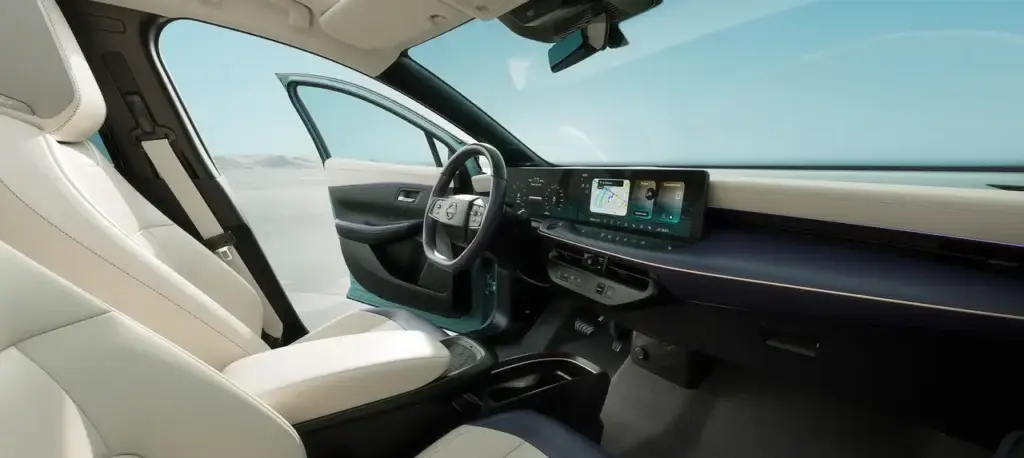
With its new CMF-EV architecture and optimised battery, the Leaf 2025 more easily meets the criteria for access to the major cities affected by the EPZs. Its improved efficiency and reduced environmental impact make it a vehicle in line with new regulatory expectations.
Although Nissan has not yet announced the exact environmental score, the model's more virtuous design puts it in a good position to meet the more stringent requirements of the eco-bonus and the environmental constraints that are gradually being imposed in major cities.
For fleets operating in Paris, Lyon, Grenoble, Strasbourg, Marseille or Bordeaux, this means having a sustainable model that complies with regulatory changes, is flexible in its use and can be integrated into a medium-term strategy without the risk of rapidly becoming outdated.
More predictable TCO thanks to battery, warranty and efficiency
The total cost of ownership depends on a number of parameters: fuel consumption, maintenance, residual value, infrastructure compatibility, insurance, bonuses and downtime. In all these areas, the Leaf 2025 offers significant improvements.
Its new CMF-EV platform reduces fuel consumption, which automatically results in a lower cost per kilometre. The adoption of the CCS standard reduces downtime and improves the productivity of field teams. Nissan has also strengthened the battery warranty and structured its maintenance programmes, making maintenance more predictable. Finally, the move from CHAdeMO to CCS ensures greater technological durability, thereby supporting residual value.
Results For businesses, the Leaf 2025 offers a more stable, clearer and less risky TCO over 36, 48 or 60 months, an essential advantage in a context where operating budgets are under pressure.
Autonomy, recharging, costs: how does the Leaf measure up in real business use?
WLTP figures are not enough: the assessment must be carried out on the road, in real-life missions, with a variety of employee profiles.
The needs of a fleet are often between :
- 60 km/day (urban technicians)
- 150 km/day (regional commercials)
- 250 km/day (inter-branch missions)
The Leaf 2025 therefore needs to be assessed against this reality.
Performance on urban, suburban and commercial routes
In town, its efficiency is excellent:
- low consumption,
- handy size,
- adapted linear acceleration,
- ideal silence for multiple tours.
On the outskirts of town, the Leaf is still very comfortable:
- sufficient autonomy for several days' use,
- more stable road holding,
- ability to handle a large number of missions without intermediate recharging.
On the motorway, progress has been significant:
- the CMF-EV platform offers superior roadholding,
- consumption remains moderate for this segment,
- autonomy means that regional journeys are now stress-free.
For field teams, the difference with the previous generation is clear: the Leaf 2025 becomes a vehicle capable of covering not only short journeys, but also more demanding missions.
Recharging time, terminal compatibility, daily planning
The switch to the CCS standard will profoundly change the way the Leaf 2025 is used every day.
It also gives them access to virtually all the fast charging points on the market, simplifying journeys and eliminating the constraints associated with CHAdeMO. Drivers benefit from a denser network, shorter stops and a much more predictable experience.
For fleets, this compatibility makes planning easier: routes are simpler to organise, recharging breaks are better anticipated and the use of in-house charging points is smoother. As a result, the model is easier to operate on a day-to-day basis, with less risk of unforeseen interruptions and less operational management.
Integration into a fleet: which professions and which driver profiles are concerned?
The Leaf 2025 broadens its range of uses.
It is no longer limited to internal travel or urban technicians: it can now cover a wide range of jobs thanks to its extended range and rapid recharging.
Sales staff, technicians, light delivery drivers: compatible use cases
It can respond effectively to the needs of :
Regional sales representatives :
sufficient autonomy for 2 to 3 appointments a day in several départements.
Urban/suburban technicians :
low fuel consumption, manoeuvrability, comfort.
Light delivery vehicles :
bigger boot, greater agility, lower costs.
Multi-agency collaborators :
versatility, easy refuelling, smooth planning.
Pool cars :
high acceptance thanks to the new design.
Limits to be aware of depending on the assignment (long journeys, complex itinerancy)
Despite the major advances of this new generation, certain constraints remain for the most demanding uses. Very long daily distances (over 350 km) require rigorous organisation, while high-speed motorway journeys continue to have a significant impact on real range. Missions involving a lot of roaming on expressways therefore require stricter planning of recharge stops and anticipation adapted to the constraints on the ground.
Use the TCO simulator to calculate the total cost of ownership of your car and compare it with its internal combustion equivalent.
New generation vs. old: what fleets need to remember
Professional comparison chart: Old-generation Leaf vs Leaf 2025
| Criteria Aspect assessed | Leaf 2018-2024 Current model | Leaf 2025 New generation | Impact fleets Operational consequences |
|---|---|---|---|
| Platform | Old base | CMF-EV | Efficiency, stability, modern technology |
| Autonomy | 270-385 km WLTP | Up to 622 km WLTP | Regional missions made easier |
| Refill | CHAdeMO | CCS | Fast network compatibility, no more constraints |
| Efficiency | Average | Improved | Lower cost per km |
| Driving aids | ProPilot 1.0 | New-generation ProPilot | Greater comfort for heavy riders |
| Connectivity | Basic | Remote diagnosis + OTA | Easier fleet management |
| Habitability | Correct | Optimised | Greater comfort and versatility |
| Design | Former | Modern crossover | Greater employee acceptance |
Strengths, weaknesses and price/use positioning
This new model offers a number of major advantages for fleets: a long range for a compact car, recharging in CCS that has finally been modernised, greater comfort for employees and smoother integration into management tools. Its versatility makes it suitable for a wide range of business uses, while its efficiency helps to keep TCO under control.
However, certain limitations remain. Production volumes may be limited at launch, which could lengthen delivery times. What's more, as with all electric vehicles, actual motorway range is still lower than the WLTP figures.
In terms of positioning, the Leaf 2025 offers an attractive price-performance ratio, especially when leased, thanks to its efficiency, modernised equipment and full compatibility with current charging standards. It is therefore a reliable and consistent option for fleets looking for a compact model that is economical to run.
Infrastructure, recharging and operational management: how do you integrate the new Leaf into your fleet?
The integration of an electric model does not just depend on its performance: it also depends on the internal organisation and recharging strategy.
Charging on site, at home or on the move: options for fleets
The Leaf 2025 can be easily integrated into :
- AC infrared 7-22 kW
- home installations for eligible employees
- CCS high-speed networks
- mixed solutions (site + mobility)
Thanks to its efficiency, it rarely needs to be fully recharged every day.
Optimising refuelling schedules and managing authorisations
Connectivity enables :
- more precise energy management
- automatic planning
- optimisation alerts
- dynamic allocation of terminals
- precise supervision of the fleet
This gives managers a clear picture of energy costs and recharging behaviour.
What Nissan really brings to fleets in 2025-2028
Nissan strengthens its professional offering with :
- dedicated contracts
- an extended battery guarantee
- pro-oriented after-sales services
- a stable volume strategy
- connected tools for fleets
The arrival of the Leaf 2025 marks a strong return by Nissan to the B2B segment.
Professional services, guarantees and contribution to CSR strategy
Nissan is backing up the Leaf 2025 with a comprehensive range of services designed to meet the needs of businesses, including competitive long-term leasing contracts, optimised maintenance, a long-term battery warranty, enhanced assistance and a network of dealers who can meet the needs of fleets.
These services provide budgetary stability, operational reliability and ease of management, reassuring both finance departments and managers.
The Leaf's improved efficiency and more environmentally-friendly production are also an asset for environmental initiatives. The Leaf makes a positive contribution to carbon footprints, CSRD audits and internal CSR communications, while reinforcing the credibility of the company's low-carbon mobility policy.
In the end, it becomes both an operational tool and a visible and coherent lever for the energy transition.
Worth remembering: is the Leaf the right choice for your fleet?
The Leaf 2025 isn't just a new version: it's a complete repositioning.
- More efficient
- More autonomous
- More technology
- Easier to integrate
- More competitive with full service leasing
- More consistent with modern business practices
It has repositioned itself as a reliable, versatile electric compact optimised for the real needs of fleets.
For businesses looking for a robust, efficient electric model without technological constraints, the new Leaf 2025 is a particularly relevant option for the years 2025 to 2028.
Manage your fleet easily with our dedicated tool
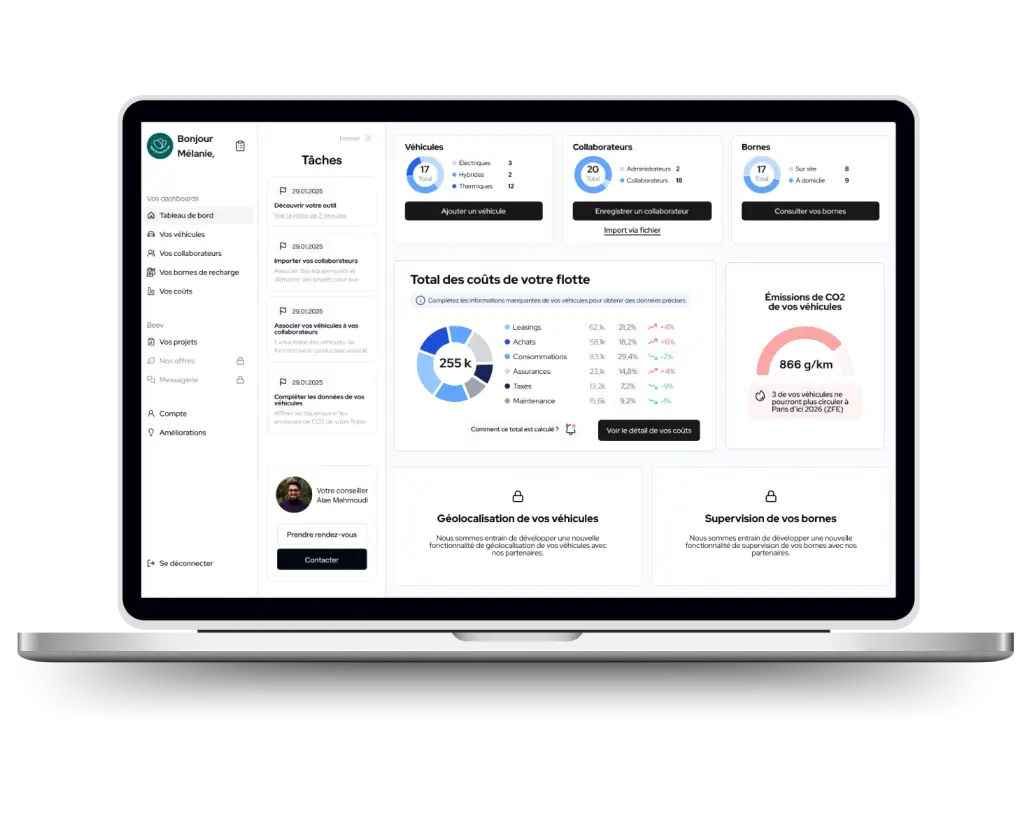
A fleet management tool from A to Z
- Add your fleet and employees in just a few clicks
- Plan your transition to electric vehicles and monitor your CSR objectives in real time
- Centralise your expenses