


























What the Kia PV5 Chassis Cab really offers
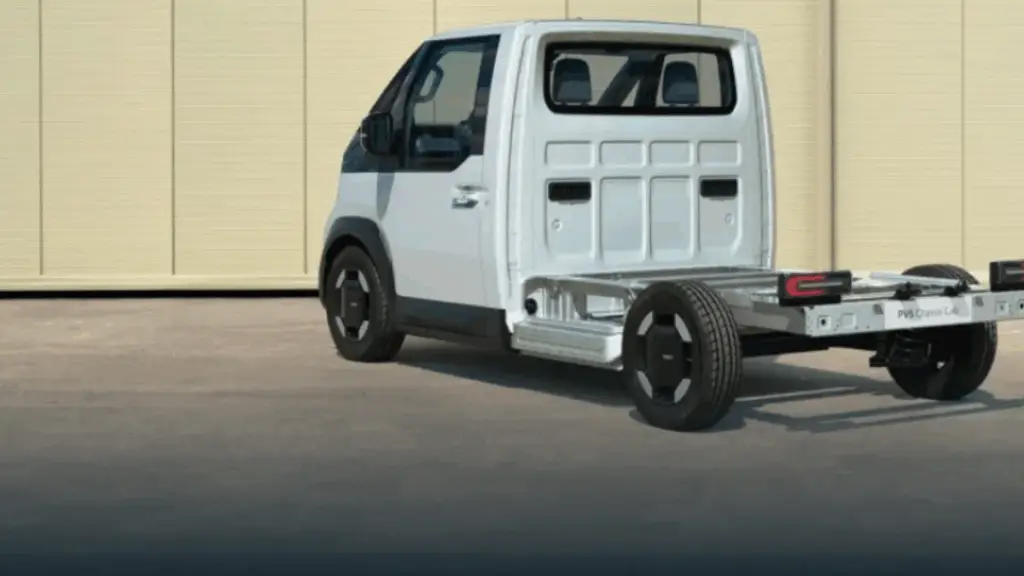
The PV5 is part of Kia's new family of modular vehicles, designed to offer a common base compatible with a multitude of professional conversions. The chassis cab version is the most versatile: It can be used to install a tipper, a refrigerated box, a delivery module, a tray or any other business equipment.
Kia has designed this model to meet the growing demand for robust, accessible and adaptable electric vans. Before discussing fleet strategy, it is essential to understand what the PV5 brings to the table in technical terms.
Performance and autonomy key facts
Le Kia PV5 Chassis Cab is based on a 100 % electric architecture designed to combine endurance, efficiency and versatility.
Two capacities of battery are available:
- 58 kWh, ideal for urban use and local tours; ;
- 87 kWh, This gives a range of around 350 to 400 km, depending on the configuration and modules.
This solid range is supported by the PBV platform, which improves fuel efficiency, stabilises driving and optimises energy recovery during deceleration. The result is a smoother ride and a more enjoyable driving experience than a converted internal combustion van.
Charging is also designed for professional use. The PV5 supports :
- up to 150 kW DC, This means you can go from 20 to 80 % in around 30 minutes; ;
- 11 kW AC, ideal for night-time on-site recharging.
This combination of autonomy and rapid recharging means that many fleets can get through a full day's work, even in intensive use. In short, the PV5 offers perfect compatibility with modern operating rhythms: little downtime, great endurance and energy flexibility.
Modularity of the chassis cab: an asset for the trades
The strong point of the PV5 is its modular PBV architecture, which means that the rear of the vehicle can be adapted to suit the activity in question. This opens the door to a wide range of configurations: large-volume body, open flatbed, refrigerated, tipper, mobile workshop module, health module, urban logistics, etc.
Unlike conventional LCVs converted by bodybuilders, here modularity is an integral part of the specification. Companies can also :
- optimise the use of the same vehicle on several missions; ;
- reduce the overall size of the fleet ;
- share vehicles according to teams ;
- adjust bodywork in line with changes in the business.
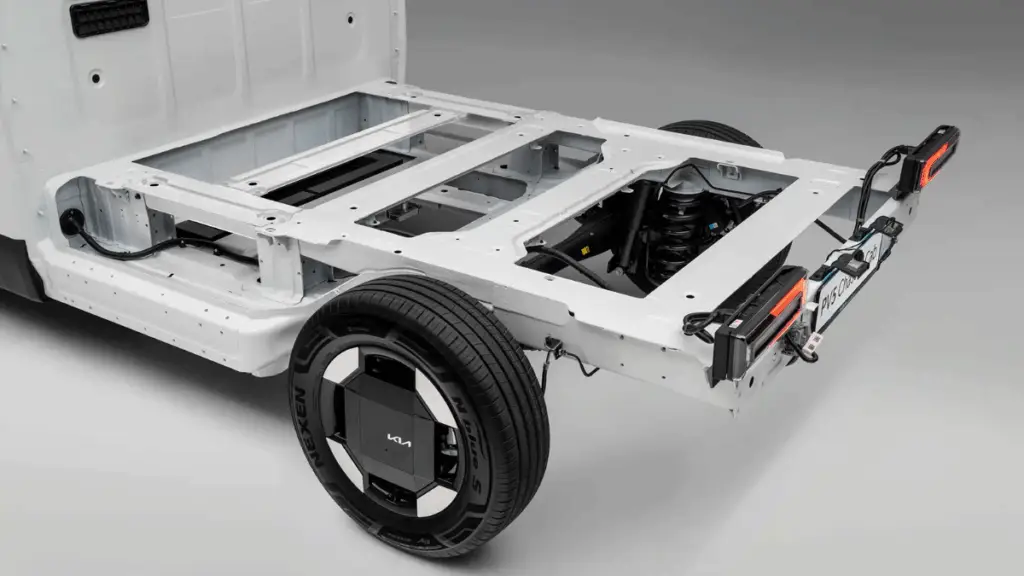
The chassis-cab of the PV5 is also designed to simplify conversions: connectors, anchoring points, electrical interface, access to the cab... everything is designed to accommodate light or heavy modules. This approach could transform the way companies design their commercial vehicle fleets.
Price positioning: a competitive electric LCV
With prices starting at 32 500 € EXCL, the Kia PV5 Chassis Cab is one of the most competitive electric LCVs in its category. This price is all the more remarkable because it comes with a solid range, a platform dedicated to intensive use and a level of modularity rarely offered on an electric LCV.
For businesses, this means easier access to electric vehicles, even for medium-sized fleets. The associated financial advantages - no VAT, attractive depreciation and reduced energy costs - further enhance the relevance of this model. The PV5 is therefore an economically viable option from the very first operating cycle, with a clear ROI for fleet managers.
Why fleet managers are interested in the Kia PV5
The arrival of the PV5 comes at a time when fleet managers need to reconcile profitability, regulatory compliance and the energy transition. The Kia model ticks several essential boxes.
A utility vehicle for everyday business use
The PV5 is clearly aimed at professionals who drive a lot, make frequent stops or have to travel in restricted urban areas. Its dedicated platform enhances manoeuvrability, comfort and stability, all of which are essential for drivers who have to carry out one mission after another.
Its road handling is more pleasant than that of an equivalent internal combustion van, with no vibrations, better acceleration and smoother driving in traffic jams. Thanks to its range and rapid recharging, the PV5 can cover a full day's work without undue stress. It is therefore ideal for both local and inter-regional fleets.
Optimised TCO thanks to electric power
One of the Kia PV5's strongest arguments is its total cost of ownership.
Electricity costs on average three to four times less than fuel. And then there's :
- Reduced maintenance (fewer wearing parts),
- reduced brake wear thanks to the regenerative braking,
- no VAT,
- stable and predictable energy costs.
This combination means that, in most cases, an electric fleet is less expensive than a combustion fleet, even if the purchase price is slightly higher. For companies with several dozen vehicles, the savings can be very substantial.
EPZ compliance and CSR benefits
With the gradual extension of Low Emission Zones, combustion-powered LCVs will be severely restricted in many cities. The PV5 Chassis Cab, 100 % electric, offers unlimited and future-proof access to these restricted zones.
For companies operating in city centres - delivery, maintenance, urban services - compliance with the EPZ is becoming an essential part of their business model.
In terms of CSR, a zero-emission van makes an immediate contribution:
- to reduce’carbon footprint travel,
- to achieve internal environmental objectives,
- to meet CSRD requirements, depending on the size of the company.
So PV5 is not just a technical choice: it's a compliance and value-enhancing tool for the company.
For which professional uses is the Kia PV5 most appropriate?
Thanks to its autonomy, modularity and attractive cost, the PV5 Chassis Cab can be used for a wide variety of applications. In fact, that's one of its main advantages: it's flexible enough to be used for several purposes within the same fleet.
Delivery and urban logistics
This is one of the areas where the PV5 excels:
- sufficient autonomy for a day's touring,
- Modular volumes depending on the module installed,
- unrestricted EPZ access,
- low running costs.
Last-mile logistics and express delivery companies will find the PV5 a solid foundation for their activities.
Maintenance, technical services and craftsmen
Multi-site maintenance companies, tradesmen, plumbers, electricians or service technicians have very specific requirements: load capacity, modularity, compartmentalised volumes, sufficient autonomy to travel to several points during the day.
With its customisable modules and robust chassis, the PV5 adapts perfectly to these constraints.
Multi-purpose for multi-activities
Some fleets need to manage a wide variety of uses with a single model. The PV5 is particularly well-suited to these needs, thanks to its modular platform that can grow with the business.
A vehicle can start life as a small delivery van, then be transformed into a mobile workshop, without the need to replace the entire fleet. This scalability is a major economic advantage.
Kia PV5 vs Renault Trafic and other LCVs: how is it positioned?
| Criteria Element assessed | Kia PV5 Chassis Cab (electric) PBV platform | Renault Trafic (diesel, 2025) Heat-powered LCVs | Conventional electric LCVs Electrified thermal base |
|---|---|---|---|
| Energy / motorisation | 100 % electric, dedicated PBV platform | Recent diesel engine | 100 % electric, platform derived from combustion engine |
| Autonomy / use | Approximately 350 to 400 km depending on configuration (PV5 Cargo reference up to 416 km WLTP) | Range dependent on fuel tank, variable fuel consumption in urban areas | Approximately 250 to 320 km WLTP |
| Platform | Dedicated PBV platform, designed for modularity | Traditional combustion LCV platform | Electrified thermal platform |
| Payload | Optimised to accommodate various professional modules | High payload (around 1,000 to 1,450 kg) | Average payload, reduced by battery weight |
| Modularity / bodywork | Tipper, box, workshop, refrigerated modules, etc. | Wide choice via specialist bodybuilders | More limited modularity |
| Base price excl. | From around €32,500 excluding VAT | Approximately €33,000 to €38,000 excluding VAT | 35,000 to €45,000 excluding VAT on average |
| Energy costs | Very low cost per km thanks to electricity | More expensive and volatile diesel | Low cost but variable optimisation |
| Maintenance | Very low: few wearing parts | Complete mechanical maintenance (filters, oil changes, etc.) | Low maintenance |
| ZFE access | 100 % compatible without restriction | Increasing constraints in urban areas | 100 % compatible |
| TCO over 4-5 years | Lower TCO thanks to energy + taxation | Higher TCO (fuel + CO₂ tax) | Varies according to range and purchase price |
| Operational positioning | Modular tool ideal for electric transitions | Suitable for long distances / heavy loads | Efficient for urban use but less flexible |
Converting your fleet to electric: the complete guide
How to integrate the Kia PV5 into a professional fleet
Switching to an electric van requires method and foresight. Adopting the PV5 must be part of an overall strategy.
Analysing needs and usage cycles
Before integrating the Kia PV5 into a fleet, a detailed analysis of usage is essential.
The aim is to identify the actual travel profile: daily mileage, type of journey (urban, suburban, interurban), departure and return times, available parking time and business constraints.
The company also needs to assess the payload required, the possible working arrangements and exposure to the EPZs.
This work enables us to check that PV5 capabilities (autonomy, modularity, size) match operational requirements. A well-conducted analysis guarantees optimal sizing of the electricity fleet and a controlled transition.
Charging infrastructure Prerequisites
The integration of PV5 depends directly on the quality of the charging infrastructure. Most fleets rely on on-site AC charging, which is perfectly suited to vehicles returning to the depot each evening. For highly mobile teams, one or two DC fast-charging stations can provide security in the event of unforeseen circumstances.
The addition of a smart charging system is highly recommended. It optimises consumption, avoids power peaks and reduces energy bills. A well-designed infrastructure increases vehicle availability, improves TCO and ensures that the electric fleet can be ramped up safely.
Deployment, training and TCO monitoring
Deployment of the Kia PV5 must be accompanied by a training phase to ensure that teams are fully conversant with real autonomy, good recharging practices and eco-driving.
Once the vehicles are on the road, the fleet manager monitors consumption, energy costs, downtime and the gains made compared with combustion engines. This TCO monitoring enables the car policy to be adjusted and the use of PV5 to be optimised on a daily basis.
Structured implementation, including training, supervision and optimisation, guarantees cost-effective deployment and a smooth electricity transition.
Worth remembering: the Kia PV5 is setting a new standard for fleets
With the PV5 Chassis Cab, Kia is offering an electric van that is versatile, cost-effective and designed for the trades.
Its dedicated platform, consistent range, competitive price and modularity make it particularly well suited to companies looking to modernise their fleet and comply with environmental requirements.
For fleet managers, the PV5 is not just an alternative: it's a new generation of electric LCV, capable of meeting real needs in the field while keeping TCO under control and preparing companies for future regulations.
Beev supports fleets in this type of transition The project involves a study of usage, recharging infrastructure, financing and deployment.
The PV5 could well become one of the flagship models for professionals in the coming years.
Manage your fleet easily with our dedicated tool

A fleet management tool from A to Z
- Add your fleet and employees in just a few clicks
- Plan your transition to electric vehicles and monitor your CSR objectives in real time
- Centralise your expenses