










Introduction, by Claudio Geyken
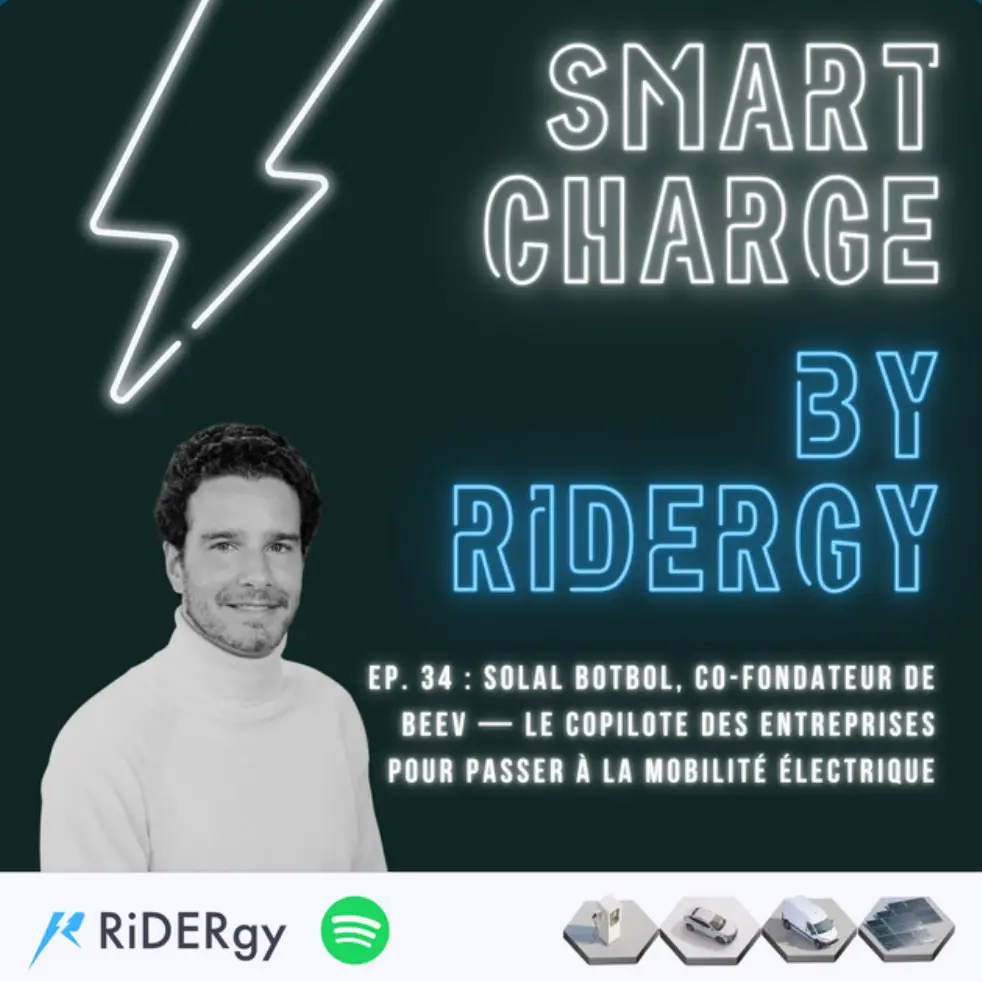
In France, electric vehicles still only account for around 3% of the vehicle fleet, but already account for almost 20% of sales. Our guest, Solal Botbol, presents Beev, the co-pilot for companies switching to electric vehicles, combining multi-brand leasing, installation of recharging infrastructure and centralised fleet management. Beev's model provides a single point of contact to control taxation, TCO and logistics, with a core target of up to 300 vehicles.
In a fragmented, highly vertical market, Beev's multi-brand strategy avoids conflicts of interest and recommends the right vehicle for the right budget and use. At the same time, Beev is deploying its Fleet Manager, software to replace Excel at customer sites. It tracks vehicles, charging points and consumption to help manage mileage overruns. These 100% European chargepoints can be installed at employees' premises in less than 10 working days, in line with the company's B Corp certification.
Let's take a look at why centralising data, contracts and energy is a real game-changer.
Hello Solal! I'm happy to be here at WeWork, your office in Paris near Station F, and to have a podcast with you.
Maintenance
First of all, can you introduce yourself?
Solal: Of course, of course! First of all, thank you for giving me the floor. My name is Solal Botbol, I'm 34 years old and I'm the co-founder of Beev. We've been helping to electrify the French and European car fleets for just over 5 years.
Personally, I've been passionate about cars ever since I was a child, and I've always wanted my professional project to have something to do with the environment and mobility, because these are subjects that drive me every day.
Where does your passion for cars come from? How did it develop?
Solal: It's something that must date back to my father.
I see mobility as a means of freedom, because it's a way of getting from A to B.
Point A is what we know, where we live. Point B can be travel, new destinations or even just going to work. In any case, it's a means of freedom. I find all the topics we're discussing today on the electrification of the electric fleet, the place of the car or the types of modalities we should be moving towards, quite fascinating.
For me, mobility is there to meet a need. It makes us wonder about the most efficient way, from an economic, environmental and ROI point of view, of getting from A to B.
Claudio : So you have this passion for mobility and you're also an entrepreneur. I heard on a podcast that at school, authority wasn't necessarily something you appreciated. In your opinion, does an entrepreneur necessarily have to have a slightly disruptive attitude to authority?
Is that why entrepreneurship was born very early on in your mind?
Solal: So I'm only going to speak for myself because I don't know if I can generalise about everyone else [laughs]. I know that, for me, it's an ecosystem that my sisters and I have been immersed in since we were little. My parents aren't originally from France...
Claudio : Where do they come from anyway?
Solal: Both my parents come from North Africa and the Middle East. My father came to France after the baccalauréat, with no ties, no network, no anything. He had to start from scratch. He went into the liberal professions of chartered accountancy and auditing. My mother, too, has always been independent. She became a lawyer, then a real estate agent, and so on.
As a result, in our parents' upbringing, there was always this culture about striving for independence because it's a way of trying to control your life and your destiny. That's the theory [laughs]! After that, does it suit everyone or not? I'd say it depends on each person's life plan. In any case, that's the environment my sisters and I grew up in.
In fact, I don't know if it was entrepreneurship that really drove me. I've always liked to dabble in all kinds of subjects, but without getting carried away.’over specialise in a given subject and say to myself: ‘I want to be the best of the best of the best on this subject and understand nothing about all the other subjects. I've always been interested and intrigued by people who touch on all subjects and reach a very high level, whether in marketing, sales, tech, product, etc. That's really what has always driven me. That's really what has always driven me.
That's why, when I was studying, I said to myself that I was going to start with the most complicated thing, and that was that [laughs]. And, in principle, I thought that engineering studies were the most complicated, so I started with that.
I didn't necessarily want to be an engineer, but I found their logic of reasoning really interesting: you put problems on the table and they have to solve them, whatever the subject. At first, they think: ‘Gee, how am I going to solve this thing, I've got no context, I don't know anything about thermodynamics or how bridges work or any other subject’.
At the end of the day, we have so many problems on the table that the mindset eventually changes. At some point you say, ‘OK, I don't know anything about it. But given all the other problems I've managed to solve before without any further context, one more or one less won't make any difference: I'll manage.’ And that's what makes the difference! You have confidence in the future, you don't necessarily know what's going to happen, but you have to have confidence in yourself and in the process to tell yourself that you're going to land on your feet. Sometimes it works, sometimes it doesn't, obviously!
But this line of reasoning really spoke to me and I think it's still with me every day.
It was after my engineering studies that I decided to go to business school to do a master's degree in entrepreneurship so that I could specialise more in the business side of things.
Claudio : In Europe, we see migrants as an opportunity to create a stronger economy. You are a very good example of this. We can also see it in the United States, where big business and the economy have been driven mainly by migrants.
Do you think this opportunity should be given even more impetus?
Solal: I think that diversity, in general, is an asset. It allows us to learn from others. In my opinion, there are limits to what you can do for yourself. In the podcast The do it yourself generation, Matthieu Stefani says: ‘We are the average of the people we meet’. There's some truth in that: whether on a cultural, economic, socio-professional or geographical level, having an environment with diversity brings richness because, in the end, no one is right.
In reality, it's only the points of view that are different and, for me, it's a proof of curiosity and open-mindedness that are essential. We notice that this can sometimes be lacking at certain times in our society. It's a pity because, instead of opposing each other, we could form a coalition and generate value together.
Claudio : We're now going to talk about Beev.
If anyone doesn't know Beev, how would you explain it in a few words?
Solal: In 2025, Beev will be co-piloting companies, employees and private individuals as they make the transition to electric mobility.
In practical terms, Beev is here to make the ecological transition simple, accessible and sustainable by helping companies to comply with the law. By compliance, I mean understanding all the fiscal, governmental and economic issues involved in electrifying your fleet for business purposes. That's the first part.
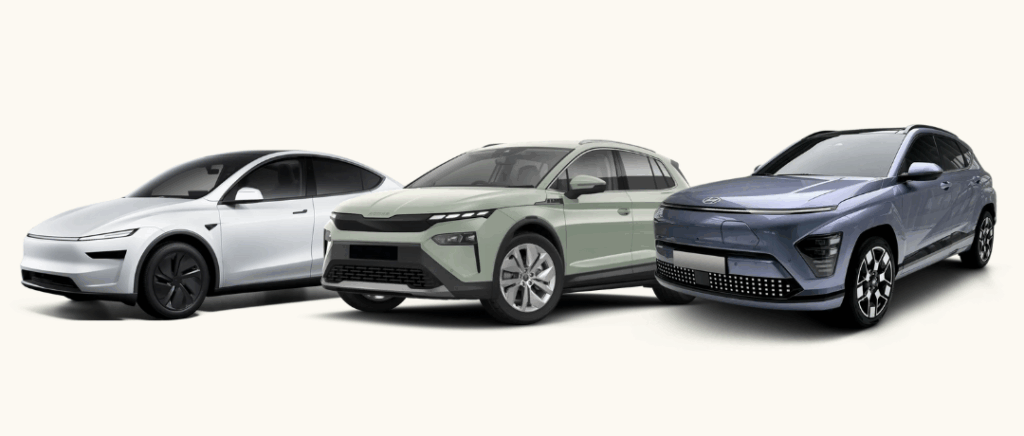
The second aspect is our distribution of multi-brand electric vehicles on leasing contracts ranging from 3 months (for employees on probation who need a company vehicle for their activity but who don't know if they will exceed their probation period), up to 60 months on a multi-brand offer. I'll come back to our decision to offer this multi-brand package.
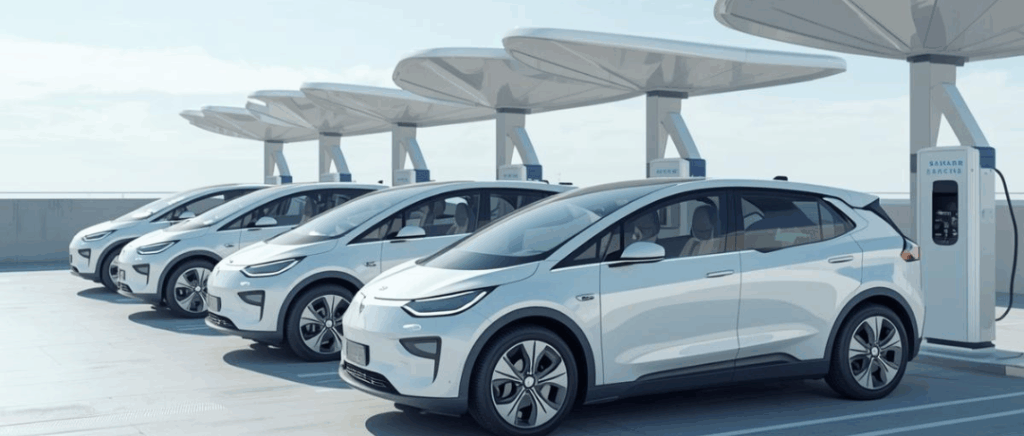
The third component involves the installation of recharging infrastructure, i.e. charging points on company sites and directly at employees' homes.
Finally, we can centralise all this (which is where the notion of co-pilot comes in) with our Fleet Manager. Since the beginning of October [2025], we have started to put it into the hands of our customers to manage their fleets of drivers, electric and non-electric vehicles, as well as the supervision of recharging infrastructures.
At Beev, we are convinced that the process of acquiring, managing and renewing fleets in favour of electric vehicles is not up to scratch. We have extremely vertical players on the market. This is one of the main factors holding back the switch to electric vehicles. The biggest brake we've heard is price. Today, there is virtually no difference in leasing prices between electric vehicles, plug-in hybrids and 100% internal combustion vehicles. As far as TCO is concerned, there are huge savings in terms of running costs if you have an electric vehicle rather than a conventional one. thermal vehicle.
And from an environmental point of view, there's no question about it. A thousand studies have been carried out to show that electric vehicles are much better for the planet over their entire lifespan than their internal combustion counterparts.
One of the obstacles to the switch to electric vehicles also concerns recharging infrastructure. But today, all the motorways in France are equipped with fast charging points with a capacity of over 150 kWh. Of course, they are not evenly distributed throughout the country.
But if we take a step back today, there are almost 40 million cars on the road in France, with only 3% of the fleet electric. So we might ask ourselves whether 100% of people are electro-compatible? Perhaps not. On the other hand, can we increase the number of cars on the road from 3% to 50%? The answer is yes, because no more than one in two people in France is not electro-compatible.
In fact, the Norwegian figures that have come out are quite interesting: between 1 January [2025] and the end of September 2025, 97% of [vehicle] sales in Norway are electric. We're talking about a country where it's cold, so we consume more.’autonomy So, yes, of course, there are some tax advantages for Norwegians in going electric. But it also means that the product meets the needs of the population, otherwise they wouldn't buy. And the same goes for France!
Here, beliefs become real barriers. Some of them do exist, that's true! There's no denying that certain profiles are not electro-compatible. There are deserts of charging points, there are ways of getting around that are not directly compatible with electricity, there is a need for vehicles that charge very, very quickly or with very long ranges but that cost too much, and that's totally understandable.
On the other hand, the reality today is that most people can switch to electric without any deterioration in their daily lives.
Claudio : You set up the company in 2020. Traditionally, we have leasing companies that are just responsible for the vehicles, others that concentrate on the terminals, others still on fleet management software...
When you arrived in the market, what problems did you discover with this?
Solal: Between 2020 and 2025, there was no real change in the market players. We realised that understanding what an electric vehicle is isn't necessarily easy for everyone. And it has to be for everyone! Because these days, you see a huge amount of advertising for electric vehicles on television, in newspapers, on your tablet, on YouTube, and so on.
But we've all been on thermal power for 100 years. So it's normal not to know what consumption per kilowatt-hour is, or even how much a kilowatt-hour costs.
What is charging power? What is the difference between alternating current and direct current? What's the difference between a Type 2 cable that I'm going to plug into my home and a Type 2 cable that I'm going to plug into my car? CCS Combo directly attached to the terminal so I don't have to take my cable out on the motorway? There's a minimum requirement for users to develop their skills, and that's bound to cause stress. There's a totally legitimate fear of making the wrong decision.
The problem lies precisely in supporting this process. Because the players in the market are highly verticalised, you have to work it out for yourself to understand all the concepts we've just been talking about. You have to look for the information yourself. And what you need to be able to identify is the economic impact of going electric.
That's why we work mainly with companies, because for them, the impact will be much greater if they make a mistake, as they have lots of cars. The economic impact has a real impact on the TCO.
That's why there's this desire to control all the economic aspects of switching to electric. We ask ourselves legitimate questions like: ‘If I go electric, will my rent cost me more? What savings will I make on fuel consumption? What about maintenance, insurance and tax?.
Over the past year, the tax system has been changing extremely rapidly! There's the Taxe sur les Véhicules de Sociétés (TVS), which is now called the TAVT (Tax on the Assignment of Passenger Vehicles), non-deductible depreciation, which allows the vehicle to be depreciated in addition to its purchase price. battery that people know little about... There are also the ecologic malus, These include a weight-based penalty, an eco-score for electric vehicles depending on whether or not they have been produced in Europe, etc.
Since 1 February 2025, there has also been the benefit in kind. To explain this simply, it should be pointed out that before, all the tax costs we have mentioned were borne by the employer and therefore by the company. But now, these costs are also borne by the employee on his or her payslip. So this has a direct impact on their purchasing power.
In the past, employers wanted to electrify their fleets in order to reduce taxation and control their TCO more effectively. However, since the introduction of the benefit in kind, this has also become a real issue for employees, because if they are provided with a polluting internal combustion vehicle, they will have a very high benefit in kind, so they will lose purchasing power. That's why they'll want to switch to an electric vehicle. This whole upstream phase is already a source of stress and error for companies and individuals. That's why we have in-house experts to help with this part of the process.
Secondly, we are distributing a range of multi-brand electric vehicles to solve the problem of the current market, where the distribution networks are dealerships. As dealers are single-brand, it seems logical that they will want to sell us their own brand. If I want a new car and I go to a Citroën dealership, they're going to sell me... a Citroën. If I'm deciding between a Renault, a Kia and a Citroën, there's going to be a conflict of interest and the dealer is bound to defend his own brand.
At Beev, we offer a multi-brand range of vehicles because we're on the customer's side. What interests us is that the customer, i.e. the company director or his employees, have a vehicle that meets their needs. It doesn't matter whether it's a Kia, a Renault, a Citroën or another brand. This approach makes a real difference, because we bring business expertise to bear on a well-considered choice. We listen to our customers to find out what's important to them in terms of their budget, the type of use to which the vehicle will be put, and so on. We then recommend the most appropriate choice to fit their budget and their TCO.
And behind all that, you have to install the terminals on the company site(s). In general, these sites are not in the same regions, whereas installers are available by region. In practical terms, this means that after calling in a tax expert, your accountant, talking to several dealers and different leasers to put them in competition with each other in order to select the most attractive lease for the vehicle chosen, you will also have to contact several installers to explain to them that you want to install a particular type of bollard with the same supervision tool and that you need to be able to centralise the bollards on the different company sites, etc, etc.
We also need to find answers to some very legitimate questions. For example, if a company director gives an electric company car to one of his sales representatives who travels to visit customers, he will wonder whether on-site charging points are really effective for him, as he will not be coming to the site just to charge his company car. He'll think that it would be much more efficient if he installed the infrastructure directly on his premises, but that still raises a lot of questions: ‘If I install charging stations on an employee's premises and he leaves the company, what will happen? How will they bill me for the electricity from their car, without me paying for their personal electricity consumption? How can I distinguish between this and the electricity used at home? etc.’.
These questions still provide plenty of challenges and subjects.
Claudio : And how do you respond to these issues?
Solal: Yes, very much so! We don't do more on the car side than on the charging point side. Our experts do both.
October 2025, installation [of charging points] takes less than 10 working days between the moment we are contacted and the day the employee has his or her installation at home. And we do this all over France, in the same way as we distribute the vehicles. We also put the leasing companies in competition with each other.
This saves our customers a considerable amount of time, enabling them to make the right decisions, to avoid making mistakes and, in short, to be in control. That's what it's all about. Am I a victim of the situation in which I find myself, or am I in control? Whether it's the acquisition, renewal or electrification of a fleet, we provide our customers with the tools they need to be in control at every level.
And the Fleet Manager that we put in the hands of our customers allows us to centralise everything at the end. Because the most challenging thing about a leasing contract, particularly for a fleet of 50 cars, is making sure that the mileage is not exceeded.
As a reminder, a leasing contract is based on a duration and mileage, with a rental charge on the other side. So, if the mileage is exceeded at the end of the contract, you have to pay for it. And it's not necessarily in the interest of leasing companies to provide tools that warn you of the daily mileage. It's the same [as for car dealers], there's a conflict of interest, because their objective is for the mileage to be exceeded so that we pay for it at the end. That's why we track mileage.
We also measure TCO per vehicle and for the entire fleet. As customers have visibility of their entire fleet (all engines combined), they can make recommendations and compare vehicles compared with those coming to the end of their lease. This enables them to find out which vehicle is best suited to their needs, and also to manage their on-site recharging infrastructures, as well as those at their employees' premises, so that they can understand their consumption and set up a recharging system.
Claudio : Is your business model more like consulting or a package?
Do you charge margins on the products you sell?
Solal: We sell electric cars with partners that our listeners, if they have fleets of vehicles or leased vehicles, will surely know. I'm talking about’Ayvens, d'Arval and the other leasing players that we will be competing with and for which we are the only point of contact for our customers.
Ayvens and Arval have a reputation for being extremely strong when it comes to very large company fleets, but when you're a craftsman, a very small business or an SME with a fleet of less than 100 vehicles, it's immediately more complicated. You can call up and no one will pick up the phone for 15 days... What's more, they are financiers, which means that they are there when the vehicle and the mileage are identified. That's when they can tell us how much the car will cost.
But this work has to be done in conjunction with all the other [leasing] players. So we save our customers time and we don't get paid by them, we get paid by the lessor. We take the margin from the margin that the lessor makes. It's painless for the customer because there are no extra costs. If that were the case, we wouldn't be relevant.
As far as the charging points are concerned, this is a service, so we sell the installation of the infrastructure on the company's site or in the home.
Do you have two or three types of product or, on the contrary, many products and terminals?
Solal: We are concentrating on European references because we have the B Corp label. In fact, we are the first automotive company in Europe to be awarded the B Corp label, and the second in the world. It's a great achievement. We want to be consistent with our values, which is why we only distribute European references that meet and cover all our customers' needs.
How did you come to want B Corp certification? What difference does it make?
From the outset, we focused on electric vehicles, saying that we wanted to be part of the transition to a sustainable future.
To do this, we thought that the best way was to have a sort of co-pilot, in other words Beev, who would support its customers in the electrification process, with a single point of contact for everything. In the same way that you have a Pennylane to manage your invoicing, Beev is your go-to to manage your recharging infrastructure on a day-to-day basis, making acquisitions, renewing the vehicle fleet...
For my partner and I, the values of environmental impact and inclusiveness are extremely important. Seeking the B Corp label came quite naturally because it establishes a company's legitimacy and proves that it is participating in the ecological transition.
In practical terms, what does being a B Corp mean on a day-to-day basis?
Solal: Above all, the label gives you credibility with your customers and partners. What really sets us apart from our competitors is our expertise in electric vehicles. Our competitors are not.
Some vehicle distributors or car brokers are going to use multiple engines and electric vehicles as an opportunity. business because in the past, they were using combustion and hybrid engines.
So it depends on the values, the trajectory, the WHY about your company and why it exists. There are also customers with the B Corp label who want to work with B Corp companies. It's all about consistency. The subject could really be summed up as coherence between the values of your company to develop what you do and how you are going to select the partners with whom you are going to work.
Claudio : Is it your electric mobility that makes you B Corp?
Solal: No, there are a huge number of criteria to meet!
Claudio : Can you give an example?
Solal: For example, building consumption. How is water used in the building? What is the source of the energy and electricity you use for your employees, etc.?.
Claudio : Oh yes, this really goes into detail!
Solal: Yes, it's quite a big file to fill in.
What are your next challenges and short-term objectives?
Solal: We have just launched our new Fleet Manager so our next challenge will be to roll it out on a large scale. It's a new tool SaaS which aims to replace’Excel of our customers so that they have just one tool.
When a customer has recharging infrastructure, they are obliged to supervise their charging points. Do they want to have a supervision tool AND a management tool? fleet management or do they want a single tool to manage everything? For us, it's the second answer.
That's why we've developed this tool, once again with the aim of improving the experience of acquiring, managing and renewing employee vehicle fleets and recharging infrastructure on a day-to-day basis. As well as rolling it out on a large scale, our challenge is also to listen to [our customers] to find out what features are essential for them. Software is designed to live and develop, so we need to know how to prioritise all the features that are essential to our customers. features and what we want to give our customers over time. And to do that, we have to listen to them.
What are your arguments for convincing customers who use Excel to switch to your Fleet Management?
Solal: Excel works very well for very small company fleets. When there is little management, the customer remains in control. This works up to around 5 cars. And I say this figure after interviewing our customers, but I know that some auditors will say ‘No, it's not 5, it's 2’ and others will say ‘No, it's not 2, it's 15’ [laughs]. They're right, it's all points of view. But we've interviewed quite a few [customers] and we've observed that one Excel is effective for up to 5 cars.
On top of that, there are people who are more or less good at developing good Excel programs and automating the process. Generally speaking, those for whom this works can continue on a Excel. But there are limits to their ability to control all the tax elements and the impact of their vehicle and fleet on TCO. Excel can't make comparisons in real time and show customers that one car is costing them so much and that it could be replaced by another that would save them money in terms of tax, fuel and rent. That's a significant factor. The second element is the management of excess mileage.
Today, a fleet manager with 5, 10 or 15 cars has two options for keeping track of his mileage. Firstly, they can install a box. The problem is that this is very intrusive and costs money. Using a device just to keep track of mileage doesn't necessarily generate an ROI. What's more, the message sent to employees telling them that a tracker is going to be installed in a car that they also use at the weekend isn't incredible.
The second option would be for employees to declare their mileage on a monthly basis. But this would mean sending them emails every month, and chasing them up if they don't reply... It's a lot of wasted time.
And for these managers, carrying out these tasks is not their only job in the company. Fleet management is part of their job in the company. It's not a full-time job, because there aren't 100 cars to manage, with continuous technical inspections, where cars have to be sent in for servicing or repairs all the time... These tasks don't take up all a manager's time, but they are very time-consuming.
If you combine this with the fact that you have to have a second, additional supervision tool to manage the recharging infrastructure, the experience is truly degraded. That's why outsourcing and relying on a tool will allow you to make the most of your time by doing things that add more value and have a greater impact on the business.
So you're targeting customers with fleets of between 5 and 50 vehicles?
Solal: Our customers' fleets range in size from 3 to 200 cars. This is an average, because we obviously have customers who are much larger or who are single owners.
Claudio : What percentage of companies in France have gone electric?
Solal: Bearing in mind that one Siret number equals one company and that there are companies with only one manager, I couldn't give an exact figure.
Claudio : Yes, it's a difficult question. But the electrification rate is indeed 3%?
Solal: 3% is the number of electric vehicles on the road in France. The percentage of electric vehicle sales in France is around 20%.
Companies are generally the ones who adapt electric mobility the most?
Solal: You're right to ask, Claudio.
The French new vehicle market is mainly driven by companies. Over the last ten years, it seems to me that the average is 60% acquired by companies and 40% by private individuals.
For the majority of them, companies buy these vehicles on leasing contracts because it's simpler in terms of management: they have a relatively new fleet of vehicles, there's less work in sending vehicles for maintenance or repair, and so on. The more time goes by, the greater the risk of mechanical problems, even though an electric vehicle has ten times fewer mechanical parts than a combustion engine vehicle.
At the end of the leasing period, the vehicles return to the second-hand market, mainly for private individuals. So it's the business market that creates the second-hand market for private individuals.
The reason why Beev has specialised more in the business sector is that it is this sector that creates the volume of electric vehicles on the second-hand market and, by extension, for private individuals. If we want to electrify the French car fleet, we have to do it through companies, because let's face it: generally speaking, a vehicle is expensive. It's the second biggest item of expenditure or investment after property. It's a purchase with a huge time commitment (excluding leasing) and a huge financial commitment.
So, on the one hand, you don't want to make a mistake and, on the other, you still want to have a choice. That's why we need to start by supporting companies in everything we said at the outset, i.e. the challenges of controlling their TCO, a constantly changing tax system, a deteriorating purchasing process, less-than-optimal management, etc. etc.
Claudio : How do fleet managers find you?
It seems to me that SEO is very important to you?
Solal: Yes, we are well referenced because we create a lot of quality content with the aim of educating our customers by providing them with reliable information on the subject. As a result, we're naturally high up on the first few Google pages without having to spend any money.’ads because we get a lot of natural traffic. And as prospects or readers find the content interesting and some of them have projects, they make the most of it. onboarding to have a relationship with us.
There's also word of mouth, which works because I think we do a good job. It shows in our reviews Google and Trustpilot. I think we're probably up to just over 600 or 700 very positive [reviews].
We have also developed partnerships with people who prescribe our solutions for their own customers. The most recent example is with the supermarket chain Carrefour, which is beginning to specialise in energy. Today, [the chain] doesn't just sell consumer goods in its shops, it's also trying to support its customers in the energy field with photovoltaic panels or electricity contracts such as Octopus. Since we won the tender, Carrefour customers wishing to install a recharging infrastructure at their home have benefited from a very attractive offer with Beev. They get a free cable, a Carrefour card, a discount on the price of the charging point installed at their home... So Carrefour is prescribing our solutions for their own customers.
And we have the same thing with the car manufacturer Porsche. Our target market is very different from that of Carrefour in terms of socio-professional category, but for whom the customer journey and acquisition experience must be beyond reproach. The fact that Beev has also won this tender demonstrates the trust and, a priori, the quality of the work we do for our customers.
Has the arrival of AI had an impact on your business?
Solal: To put the development of the car market in context, [it should be remembered that] it is basically an extremely physical market. Initially, it was driven by people going to car dealerships.
There was a turning point from, I think, the mid-2000s onwards, with the rise of the Internet and the digitalisation that was beginning to take place. It seems to me that today, the number of people visiting concessions has been divided by 3 over the last 15 years.
Generally speaking, there is a real need to digitalise vehicle acquisition. Over the last five years, we have seen a new revolution in electrification. And after all that, of course, there's the subject of AI.
At Beev, we use AI as a tool to deliver the best experience to our customers. That's why we're going to use it in our Fleet Manager in which we will run algorithms to find the best vehicle recommendations for our customers based on what they want.
[With AI], we're improving operations to be much more responsive and deliver a better quality service for our customers. In fact, we're using AI to go faster in what we need to develop internally to deliver the best experience for our customers.
Claudio : In relation to the podcast called Smart Charge So, energy management, we haven't yet talked about a big challenge, even though I think you certainly have it in your ecosystem, it's ...
Solal: V2G? [laughs]
Claudio : That too, but the main challenge lies in the electrical installations. After a certain threshold, you start to be imitated in terms of the power that can pass through the cable, don't you think?
What opportunities are there around smart charging, i.e. recharging during the hours when it's cheapest, for example?
Solal: What we've noticed among our customers is that there's a real need to master and understand how to electrify their car parks.
To do this, technicians are mobilised to see if the power is available and, if not, to define all the electrical engineering that needs to be done. We try to anticipate the need to electrify the fleet.
That's why Beev is so unique. We always draw a parallel between the company's fleet and its need for electrification with the installation of recharging infrastructure. I think it's important to remind our listeners that electric vehicles vary in the power they can accept in AC and DC. Some accept a maximum of 7 kWh, others 11 kWh, others 22 kWh with alternating current, but for direct current, it's very disparate. Some cars accept 100 kWh and others more than 400 [kWh]. [This disparity] is part of the decision-making process and also defines the type of charging point to be installed and how the vehicle fleet will evolve over the coming months and years.
That's why we're pre-dimensioning the electrical engineering, so that we know what cabling will be needed for future recharging infrastructures because, once again, the companies that install recharging points generally call on us again to add more points to the same car park. At least that's what we've noticed.
Claudio : And processors too?
Solal: We haven't needed transformers that much. We don't do too much direct current, we're really concentrating on the 90% of electric vehicle recharging [that takes place] at home or at work. That's why we've concentrated on AC charging points.
We do a few DC terminals, which account for 10% of our business, but they're a bit less of a focus for us. We really prefer to concentrate on why people switch to electric, i.e. to have a permanent solution for recharging on a daily basis.
The people switch saying to themselves ‘I know I can recharge my vehicle at home or at my place of work’, they won't switch not because they think ‘There are charging points at petrol stations’. That's why they travel, get around and make long journeys.
But the number 1 reason is ‘Do I have a long-term recharging solution for everyday use or not?’
Claudio : We were talking about’Octopus but there is also BYD, which provides its customers with its advanced driving assistance system free of charge.
What's your opinion of similar offers?
Solal: You get the feeling that it's not yet an instant subject for most [people] because they're already saving a lot of money by switching from combustion to electric.
We're trying to educate them by telling them to be careful with the electricity bill, which is going to rise and which they're going to want to optimise. I think that could be a second step.
First, they get their bearings to see if everything is running smoothly, to make sure that they maximise the use of electric vehicles, i.e. make sure they are well charged, well used while roaming, at home, at work, etc. Then they take care of the optimisation part. Then they will take care of the optimisation part.
This part is essential and primordial, but it is not stage 1. Step 1 is first to deploy and then to analyse and optimise. But you don't start directly with optimisation. In fact, that's why we thought that the vehicle to grid was something that was going to be in great demand from our customers but, for the moment, not at all.
Claudio : When you say ‘stage 2’, do you have a date in mind?
Solal: In the automotive market, cycles are fairly long. A leasing contract lasts for 3 years, and the charging points we install are there for quite a few years...
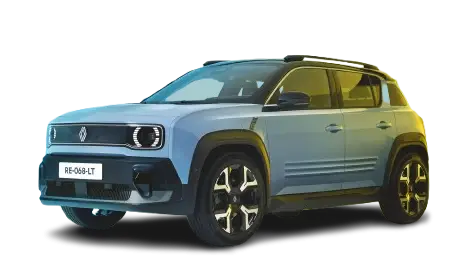
For the vehicle to grid, You have to look at the range of cars on offer. There aren't that many electric vehicles on the market. vehicle to grid. Some do it at the marketing level, like the Renault r5. The dealers are also our partners because we buy [the cars] from them. And what we've noticed is that customers buy Renault r5s for the style or for the vehicle itself, not because they're good value for money. vehicle to grid. In addition, the vehicle to grid cost too much for what customers are considering. There is still work to be done, as with any new technology.
After that, it's industry: the more you produce, the greater your production volume, the lower your costs and, by extension, your selling price. The vehicle to grid is not really an issue at the moment. It will be more of an issue at the end of this decade, around 2029-2030. At that point, the vehicle to grid will start to become a subject of optimisation that will come to the table. We will no longer be at the stage of, pardon the Anglicism, early adopters who think it's great to vehicle to grid.
We have not yet reached the stage of mass-market. People are still discovering electric vehicles, so in terms of processing Information on how an electric vehicle works will come later.
Claudio : I agree that this will come later, but I don't think France is too much of a challenge. For example, Holland has very congested networks, so we can't afford to install a lot of charging points. There isn't much power available, so you have to recharge intelligently, otherwise you can't recharge.
Have you ever faced the challenge of not being able to connect to the network in France?
Solal: France sells more electricity abroad than it needs. So, in principle, for the moment, it's ok. Until when will it be ok if we increase the fleet from 3 to 10%? I think there's still quite a bit of room for manoeuvre, but to be completely transparent, I can't say where the cursor is.
You are based in France. Do you have operations in other countries?
Solal: For the moment, we're all over France. For us, the biggest challenge will be to roll out the Fleet Manager. The French market is already a huge playing field, and we're very small. We want to increase our market share in France before we go international.
And if we have to go international, it will naturally be to the Benelux region, as we already have requests from there. These regions are also a little more electro-compatible than others in terms of financial resources and acculturation to company cars.
Nevertheless, internationalisation will not really be a topic for the next few months. We're going to concentrate on France first.
Can you give me some figures about your company? Revenue, number of employees...?
Solal: We're growing fast, with 3-figure growth every year. We have a team of 40 people today...
Claudio : Is everyone in this building?
Solal: There are 3 people on full remote, otherwise we're all here. We're deploying well, even though we'd obviously like to do a lot more. But we're making progress.
Claudio : You said there was a lot to be done in France. But [electrics] have also exploded in Belgium in recent years. Maybe they get more subsidies?
Solal: In Belgium, we also have an extremely important company car culture!
Claudio : Yes, and they speak French, so I asked myself why didn't you try to go to Belgium?
Why didn't you try to go to Belgium?
Solal: To choose is to give up. For us, the first choice we made was to maximise the value we bring to our existing customers before looking for new ones. And maximising the value we bring to our existing customers means putting in their hands the best possible service. Fleet Manager that we've developed so that [they can] manage everything. It's a question of choice.
Are we missing out on opportunities? Yes and no, because you're missing out on the opportunity in Belgium, but if you don't do the right thing, you'll miss out on a lot more. Fleet manager in France, we're missing the opportunity to support our existing customers and maximise their experience.
Claudio : What would be the big challenges if you wanted to launch Beev internationally?
Are the challenges more product-related or more operational?
Solal: As far as operations are concerned, we've anticipated this to some extent. Of course, the operational side is a challenge for every company [laughs], especially when you're looking to expand.
I think the biggest challenge in going international is not to make the mistake of thinking that it's enough just to do the right thing. ctrl c + ctrl v, In other words, we copy and paste what we've done in our home country and replicate it elsewhere. That's not how it works. Each country has its own specific characteristics and way of operating, and it's up to you to adapt to them, not the other way round. If you don't adapt, you'll go out the back door. So I think the biggest challenge is finding the right people in the country in question.
For example, if we launch in Belgium tomorrow, [the challenge] will be to find the right person. Because you might think that one of the founders is going, but the reality is that I don't know the Belgian market. So wouldn't it be quicker to take on someone who already knows this market a lot better [than I do] and who knows the mistakes not to be made if you want to replicate the French model?
For me, the biggest challenge is human resources: finding the key people who will make the difference. Sometimes it's not a question of quantity but quality. It's better to have one great person than a sub-optimal team of 5 or 6 [people].
What is the recurring myth that prevents the acquisition of an electric fleet?
[The myth is] the limits: thinking that you're not electro-compatible, that having an electric vehicle is too expensive, that it doesn't have enough range, that it doesn't recharge quickly or that there are no charging points. None of that will be true in 2025! It may have been true at one time, with a lot of anti-electric lobbying, but with the range on the market in 2025, it's no longer true in most cases.
What is the biggest challenge that SMEs underestimate and how can you help them?
Solal: The real challenge is to master all the elements of electrification. As I was saying, you need to be in control of all the parameters of your TCO, fiscal, economic and so on.
Access to information is sometimes very complicated and not necessarily reliable. In France, the government website and the URSSAF website are a good source of data. However, we noticed some errors on the URSSAF site! We contacted them to let them know and they changed their site. So getting access to the right information is really difficult.
And the real challenge is everything we've been talking about for the last hour, [namely], the route! It's challenging, sorry, [but], it's rubbish [laughs]. I don't know how else to put it. It's not suitable, and even less so when you're a company. Fleet management is one of the tasks of the person in charge. When there are 20 or 30 cars in the fleet, it has a huge impact on the company's finances. We need to optimise the company's finances, which is a real challenge, especially in 2025 when we're talking about a period of austerity and crisis. Everyone's paying attention, so going electric isn't a financial effort, it's a way of managing the environment. cash. So do it!
And there's one last thing I don't understand: we were talking about electricity earlier. Electricity is cheap in France and it comes from... France. [However], 100% of the petrol and diesel used in our vehicles is imported.
Why don't we want to develop our economy when we produce energy? To me, this is a real aberration. We're finding all kinds of obstacles [to switching to electric cars] and at the same time we're saying we have to buy French. That's fine! But if we want to consume French and our energy consumption isn't French and is 100% imported (from countries that aren't democracies, by the way), then are we really being consistent? Once again, I'm not passing judgement! It's just an observation. I don't understand this logic.
We can develop our industries and our economies. Electricity is carbon-free, it's not very expensive and it's 100% French. Why are we using imported energy sources that contain much more carbon and cost much, much more?
Claudio : Yes, we spend hundreds of billions of euros a year [on imported energy and] we could be investing in something that doesn't destroy the climate.
Solal: That's something I don't understand.
Claudio : So you created the company in 2020. It's now 2025 and you and your team have already succeeded.
Solal: Oh no, we're still at the beginning! I feel like we're still at the bottom of the hill.
Where do you think Beev will be in 5 years' time, in 2030?
Solal: In an ideal world, although it will depend solely on us, our efforts and the extent to which we are able to put this in place (there is also the market to take into account, of course), we would like to become the reference co-pilot for companies in the management of their fleet, the acquisition and renewal of their vehicles, their recharging infrastructure and the management of their employees.
Just as there are Pennylane as an invoicing tool for the company, Alan for the mutual, Qonto for the bank, there would be Beev to manage the acquisition, renewal and management of a fleet. We'll have succeeded when we've achieved that.
Claudio : Where can we find you if we want to get in touch with you or the company?
Do you have any final message or request for listeners?
Solal: I only have one social network: LinkedIn. So I can be contacted at Solal Botbol de Beev on this network. As far as demand is concerned, we're generally looking for talent for all positions. [To join Beev], you have to like 5 things, or at least adhere to our values, of which there are 5.
The first is excellence. That's what we're aiming for. Are we going to wait for it? I don't know but, in any case, if we don't aim for it, there's no risk of achieving it. So we're looking for people who want to strive for excellence.
The second [value] is people who have this notion of ownership i.e. who go all the way when they start a subject and don't stop along the way. And if there's a problem, they have to take the initiative to solve it.
The third [value] is team spirit. [You have to be able to put your ego aside to make it a collective success. For us, that's very important and it also helps to create a very good atmosphere in the team, despite the fact that everyone is striving for excellence. One doesn't work against the other.
The fourth [value] is that we do all this for our customers: ‘How can we remove the friction of acquisition, management and renewal? You really have to think that every decision you take is customer centric in other words, very customer-focused. It starts and stops with the customer value delivered.
The last [value], for us, is rigour. It takes longer to do things wrong than to do them right, so you might as well do them right straight away. It saves everyone time and shows that you respect yourself, the people you work with and your customers.
So, if you embody these 5 values and you think you're a talent in your sector, don't hesitate to contact me on LinkedIn by sending me your CV and telling me what your area of expertise is. Male or female! I want to say it.
We were talking about diversity [earlier] and I think there's a lack of diversity and inclusiveness in the automotive sector in general. I have a co-founder and we've noticed just how very, very, very masculine this profession still is. That's why my message is for everyone.
Claudio : Thank you very much Solal and good luck with the rest of your work.
Solal: Thank you Claudio for your time.
Conclusion, by Claudio Geyken
What emerges from my conversation with Solal is clear and quantified.
Beev targets fleets of between 5 and 300 vehicles, with the majority between 5 and 200. The Fleet Manager centralises data and compares the TCO per vehicle in real time, freeing managers from time-consuming tasks and making decisions more reliable. In terms of infrastructure, the’AC [alternating current], covers 90% of current needs, with installations taking less than 10 days at employees' homes and sizing designed in advance to take account of the power actually accepted by the vehicles.
Today, France can absorb up to 10% of electrification without any major risk to the network, paving the way for a gradual ramp-up. V2G [vehicle to gridAccording to Solal, this is an end-of-decade stage, when the compatible offer will be wider and more affordable.
Beev is moving forward with 3-digit growth, a team of 40 people in Paris, partnerships with key influencers such as Carrefour and Porsche, and a roadmap that prioritises the deployment of the Fleet Manager in France, with a step towards Benelux. [Their certification] by B Corp (the leading automotive company in Europe and the second largest in the world) lends credibility to our ambition to be the integrated benchmark for electric fleet management by 2030.
Thanks for listening, share the episode and see you soon.