

























LOM Act: a reminder of the framework and ambitions

Adopted at the end of 2019, the Loi d'Orientation des Mobilités has a clear objective: achieve carbon neutrality by 2050. The transport sector, responsible for around 30 % of national emissions, is naturally at the heart of this transformation.
The LOM law requires companies with more than 100 vehicles (light or commercial) to progressively include a minimum proportion of low-emission vehicles (LEVs) in their fleet each time it is renewed.
A gradual but demanding timetable
Quotas are designed to increase over time:
- 10 % of low-emission vehicles on renewal in 2022,
- 20 % in 2024,
- 40 % in 2025,
- 50 % in 2027,
- up to 70 % on the horizon 2030.
Although this timetable can vary according to the size and type of company, it sets out a common ambition: to accelerate the decarbonisation of commercial land transport.
Beyond percentages, the LOM aims to bring about a lasting change in the culture of mobility within companies. Lelectrification must no longer be a stand-alone project, but an integrated pillar of the CSR strategy and overall performance.
Use the TCO simulator to calculate the total cost of ownership of your car and compare it with its internal combustion equivalent.
A symbolic step: accountability for electrification
For several years, greening obligations were mainly based on intentions or internal commitments. But the recent reporting obligation transforms this logic: from now on, companies must be accountable.
Each year, they are required to declare the composition and development of their fleetand specify the proportion of low-emission vehicles.
This official report, sent to the authorities, marks the end of declarations of intent: now it's time for the real thing. actual measurement.
A new era of transparency
This requirement is profoundly changing the way companies operate.
The dispersal of practices, some well advanced, others still at a standstill, is becoming visible and comparable.
This gives the State, partners and customers access to a consolidated view of transition efforts of the French economic fabric.
Eventually, this reporting will make it possible to identify pioneering playersThe aim is not only to promote the most virtuous companies, but also to identify those that are lagging behind so as to accelerate the movement by example or coercion.
By making progress measurable, the LOM transforms greening into a verifiable performance indicatorThe same goes for financial or CSR reports.
The hidden objectives behind the obligation to declare

Behind the apparent technicality of this measure lie multiple objectives, which are at once ecological, economic and structural.
1) Accelerating transition planning and measurement
By requiring annual reporting, the legislator is creating a dynamic for continuous improvement. Fleets now have to plan their renewals over the long term, anticipate delivery times for electric vehicles, and adjust their energy mix to meet quotas.
This process encourages companies to adopt a forward-looking vision of their mobility.
Reporting becomes a strategic management tool: it raises awareness, mobilises internal resources and structures a medium-term roadmap.
In practical terms, this means :
- better monitoring of overall emissions,
- prioritisation of investments,
- and greater inclusion of mobility issues in management discussions.
2) Create a national mobility database
The reporting obligation provides the government with an unprecedented tool: real-time mapping of the energy transition of fleets.
This data will make it possible to :
- steer the national sustainable mobility policy more effectively,
- adjusting public support schemes,
- anticipate infrastructure needs (terminals, recycling, logistics),
- and coordinate efforts between the private sector and local authorities.
Ultimately, France will have a unique information base, paving the way for applied research, modelling and optimisation of public transport policies.
3) Combating greenwashing and boosting credibility
Finally, transparency is the best antidote to greenwashing. Declarative reporting provides partners, investors and employees with a tangible indicator of the progress we are making.
Companies can no longer be satisfied with simply displaying an ambitious CSR strategy: they have to prove it with figures.
This is a major step forward for the credibility of environmental initiatives and a lever for building confidence among stakeholders.
A change in attitude for companies and their fleets
The reporting obligation implies a real cultural change for fleet managers and general management. Where once the issue of greening could be approached as a simple regulatory matter, it is now becoming a key issue for fleet managers. strategic and organisational challenge.
Strengthened governance
Collecting and centralising data requires new coordination between departments:
- the CSR Department for environmental consistency,
- the finance department to measure TCO,
- the HR department for the management of employee vehicles,
- the IT department for monitoring and reporting tools,
- and, of course, the fleet manager, the operational linchpin of the transition.
This new framework encourages companies to better integrate mobility issues into their overall sustainable development policy, and enhances the professionalism of fleet managers.
Practical challenges for fleet managers
Faced with this greening and annual declaration obligation, many challenges arise on a daily basis:
Improving TCO and purchasing processes
Electrification is turning the Total Cost of Ownership benchmark on its head.
The acquisition cost of an electric vehicle is still higher, but the savings in energy, maintenance and tax quickly offset this difference.
Fleets therefore need to adopt a full TCO analysis, taking into account the entire lifecycle, from recharging to remarketing.
L'recharging infrastructure the sinews of war
At the end of February 2025, there were more than 160,000 public charging points in France, an increase of 30 % in one year. But the distribution remains uneven, and internal needs are growing faster than public supply.
Installing on-site charging points, negotiating preferential rates and organising night-time recharging are becoming strategic projects.
Hybrid, multi-site or mobile fleets require flexible, connected and interoperable solutions.
Data as a new skill
LOM reporting requires complete traceability of vehicles: registrations, fuel consumption, emissions, mileage and energy used.
This means increasing the digital skills of our teams and adopting integrated management tools.
Platforms such as Beev Fleet Manager can centralise this information, automate regulatory monitoring and generate the reports needed to ensure legal compliance, while managing TCO and environmental performance.
The human factor
No greening can succeed without the support of our employees.
Supporting change, training in electric driving and raising awareness of eco-gestures are essential to ensure operational success.
Manage your fleet easily with our dedicated tool
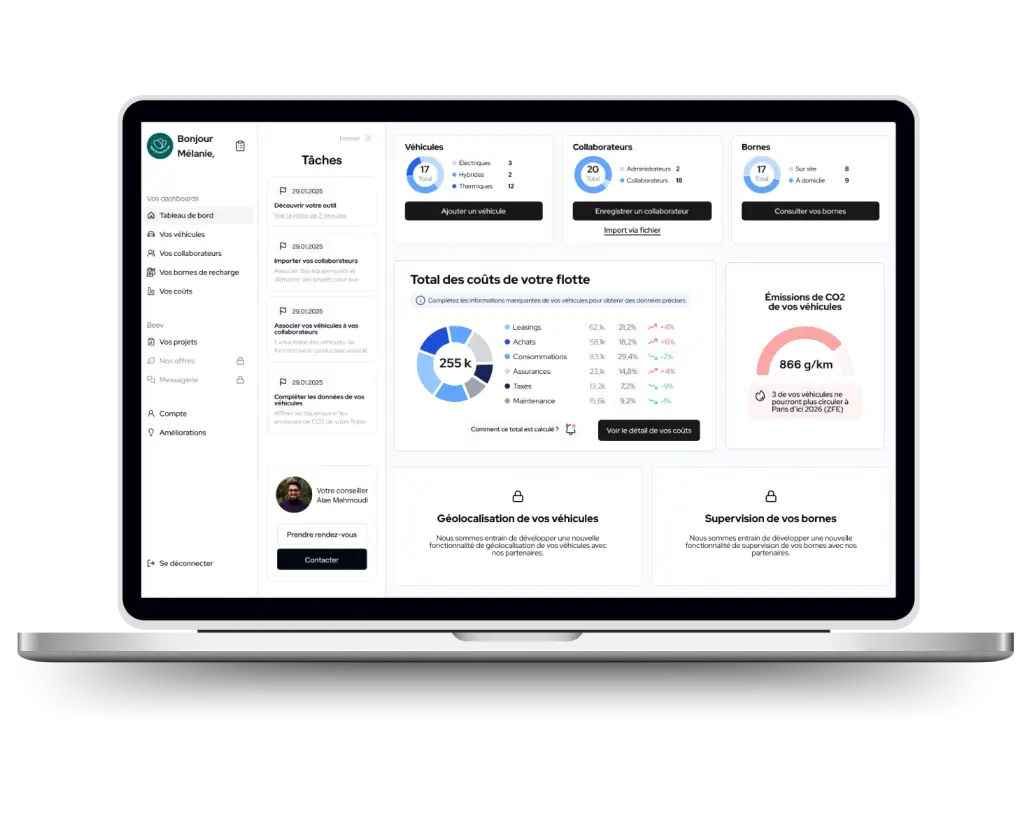
A fleet management tool from A to Z
- Add your fleet and employees in just a few clicks
- Plan your transition to electric vehicles and monitor your CSR objectives in real time
- Centralise your expenses
Strategic opportunities to seize
Behind the regulatory constraint lies a formidable leveraging opportunities for companies.
Electrification strengthens economic competitiveness and CSR reputation.
Companies that can demonstrate concrete results in terms of electrification will benefit from a commercial and institutional advantage They attract customers who are sensitive to sustainability, respond more easily to public tenders and improve their attractiveness to talent.
Long-term profitability
Studies show that an electric vehicle can reduce the overall cost of mobility by 25 to 30 % :
- cheaper energy (≈ 3 € / 100 km compared with 12-15 € for a combustion engine),
- simplified maintenance (fewer wearing parts),
- tax advantages (exemption from TVS, bonuses, depreciation).
If you add up all these savings, a well-managed electrified fleet can generate annual savings of several tens of thousands of euros.
An HR and employer brand asset
Offering employees modern, sustainable vehicles is becoming a strong employer brand argument.
It's also a direct response to the expectations of new generations, who are more aware of environmental issues and social responsibility.
A regulatory and financial advantage
Being among the first to make a success of the transition means gaining access to bonuses and public aid, improving non-financial indicators (CSRD), attracting new markets or responding to new specifications accelerated by public procurement.
In other words, acting early means investing wisely.
Outlook: what happens after the LOM?

While the LOM Act has laid the foundations for a lasting transformation, it is only one stage in a wider process.
Parliamentary debates are already raising the possibility of lowering the application thresholds to 50 or even 10 vehicles, which would eventually include SMEs and VSEs.
The aim is clear: to democratise the transition across the entire economic fabric, not just the major groups.
Other regulatory innovations are expected:
Extension of harmonised European reporting :
The European directives CSRD (Corporate Sustainability Reporting Directive) and SFDR (Sustainable Finance Disclosure Regulation) will soon harmonise environmental reporting obligations. By 2026, all companies with more than 250 employees will have to publish precise indicators on their direct emissions (scope 1) and indirect emissions (scope 2 and 3), including those linked to professional mobility.
- Every kilometre driven, every recharge and every litre of residual fuel will be included in the consolidated carbon footprints.
- The Finance and Sustainable Development Departments will need to work closely together to ensure the reliability of the data transmitted to Brussels.
- Companies that rely on digital tracking tools, such as Beev Fleet Manager, will have a major advantage: automated reporting, traceability of emissions, and direct compatibility with the formats required by the CSRD.
Systematic integration of soft and shared mobility:
The next stage will involve fully integrating alternative modes of transport: bicycles, car-sharing, car-pooling and combined mobility. Companies will no longer be assessed solely on the proportion of electric vehicles in their fleet, but on all their travel solutions.
The aim is to move from vehicle management to usage management.
Fleets will no longer be just electric; they will become flexible, optimised and multimodal.
Solutions such as Beev are already supporting this trend, by integrating the management of several types of mobility into their platforms, enabling fleet managers to anticipate these new obligations while optimising their costs and profitability. carbon footprint.
Tighter controls and automated penalties :
The government plans to cross-reference public and private databases (registration, insurance, tax returns) to check compliance.
Penalties could take the form of progressive incentive taxes or reporting penalties for inactive companies.
Development of green taxation and financial instruments:
Green taxation will become one of the most powerful levers for guiding business choices.
After the era of obligations will come the era of targeted and differentiated incentives, adapted to the maturity and sector of activity of each fleet.
Conclusion
The greening obligation, combined with the new requirement for transparency in reporting, means that company fleets are entering the era of measured responsibility and concrete action. This new paradigm is overturning practices and accelerating innovation, inviting all players to rethink mobility as a lever for competitiveness, social progress and ecology. To keep up with the times, companies need not only to adapt, but also to anticipate, structure and capitalise on each stage of their transition. From now on, the road to sustainable business mobility will be paved with proof and example.
Tools such as Beev Fleet Manager jplay a key role: centralising data, automating reporting, anticipating refuelling needs and managing operating costs.