























Why eco-score is becoming an essential criterion for fleets

Much more than just a criterion for access to the eco-bonus, the eco-score has become a structuring tool for companies. It influences leasing rates, residual values, vehicle policy and the organisation's environmental image.
Until now, manufacturers have communicated extensively on the basis of theautonomy or running costs. Now, real environmental performance, measured and verified, is reshuffling the deck.
Fleets therefore need to incorporate this new indicator into their strategy, or risk increasing their TCO or staying with models that do not comply with future environmental obligations.
A new purchasing logic imposed by regulations
France has made the eco-score a prerequisite for obtaining the ecological bonus. For professional buyers, this change imposes a new logic:
- A poorly rated model automatically becomes ineligible, even if it is modern or efficient.
- Leasing companies pass on eligibility for the bonus in their lease payments, which has a direct impact on their leasing offers.
- Finance departments are now requiring ecoscore to be included in TCO analyses, in the same way as fuel consumption or VAT.
- Car policies must be updated to include this new mandatory filter.
Paradoxically, this regulatory constraint benefits fleets: it ensures that the models selected have an objectively verifiable environmental impact, and reduces the risk of choosing a vehicle that is very expensive to produce or difficult to recycle.
The direct impact on the choice of models available in 2025-2026
The eco-score has already triggered a major movement in the market: some very popular electric vehicles have been withdrawn from the bonus because their production was too carbon-intensive or their supply chains too remote.
Conversely, compact and optimised vehicles, which are often more rational for fleets, have risen to the top of the ADEME rankings.
In practical terms, this means for companies :
- fleet renewals to be reconfigured,
- the necessary trade-offs between power, autonomy and impact,
- budget forecasts dependent on the score,
- increased vigilance to anticipate the changes to come in 2025-2026.
In other words, ecoscore is no longer a secondary parameter. It conditions access to financial benefits, the company's CSR image and regulatory compliance.
How the eco-score is calculated: what managers need to understand
The eco-score is based on a rigorous methodology determined by theADEME. Contrary to popular belief, it is not limited to the battery. The score is a complete snapshot of a vehicle's environmental impact, evaluated over its entire life cycle.
To make the right decisions, managers need to understand what really influences the score: these are the factors that explain why some models score highly and others are penalised.
The five pillars assessed by ADEME
The eco-score is based on five families of criteria:
1)The carbon impact of production
- carbon footprint of the country of assembly,
- energy used in factories,
- manufacture of the battery (the largest item).
2) Logistics and transport
- distance between production sites and France ;
- means of transport (air, sea, rail).
3) The impact of materials
- presence of recycled materials ;
- carbon intensity of aluminium, steel and electronic modules.
4)Recyclability
- end-of-life recovery rate ;
- the manufacturer's ability to reintegrate materials in a short cycle.
5) Performance in use
- energy efficiency (kWh/100 km) ;
- battery capacity vs vehicle weight.
These five pillars rebalance the market: a two-tonne SUV, even if optimised, will find it hard to compete with an economical city car produced in Europe.
Why some vehicles are rated higher than others
Highly classified models combine several advantages:
- European production from a low-carbon electricity mix;
- batteries of reasonable capacity, and therefore less costly from an environmental point of view;
- optimised industrial processes (e.g. recent platforms, robotised manufacturing) ;
- high levels of recyclability or use of reused materials.
Conversely, low-rated vehicles often share the same shortcomings:
- production in countries with a carbon-based electricity mix;
- long-distance transport ;
- oversized batteries for the purpose ;
- high weight leading to poor efficiency.
For a fleet manager, these differences explain why the best-rated models are often also the most economical in the long term.
Electric cars really deliver on eco-score
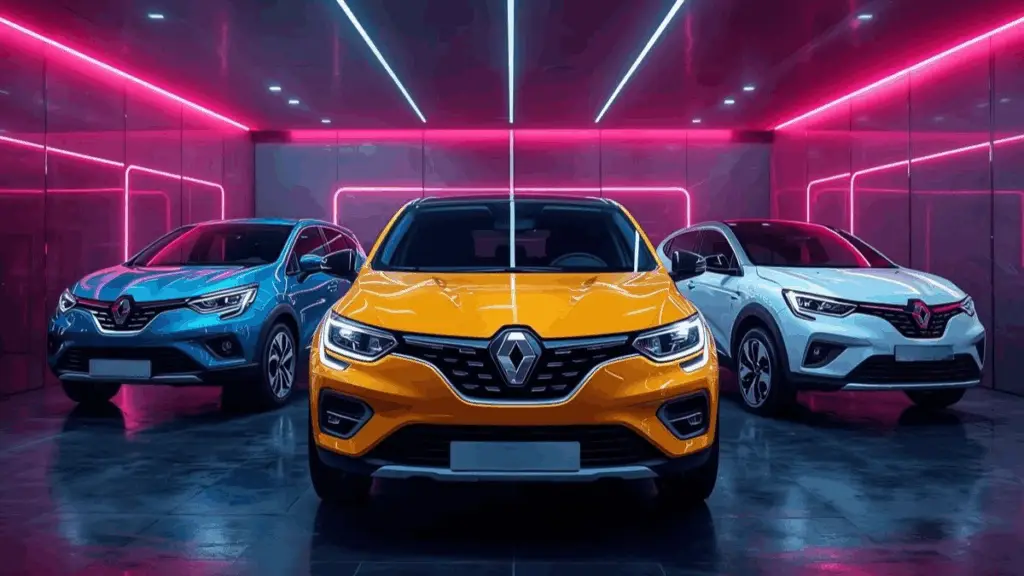
The latest update of the environmental score published by ADEME has profoundly reshuffled the deck. Some models, sometimes unexpected, are proving to be particularly well suited to the needs of fleets, thanks to their controlled environmental impact and excellent efficiency.
According to the most recent data available on the official ADEME portal, several electric vehicles stand out with a high eco-score. Here are the main models:
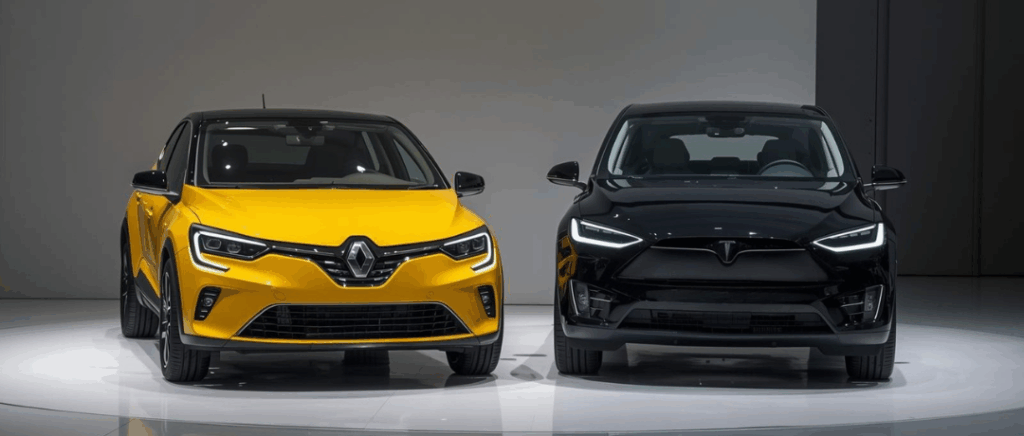
The most virtuous models for fleets (examples: ë-C3, Twingo E-Tech, Mégane, Model Y...)
The top-rated vehicles combine local production, a compact battery and remarkable efficiency. Among the most suitable for professional fleets:
Citroën ë-C3
- Designed and produced in Europe, equipped with a compact LFP battery, it combines controlled pricing, efficiency and reduced impact. Ideal for urban and suburban journeys.
Renault Twingo E-Tech
- Ultra-light, highly efficient and made in Europe. One of the best eco-scores on the market. Perfect for urban technicians and intra-zone travel.
Renault Mégane E-Tech
- French production, remarkable efficiency and optimised supply chain. Very well positioned for regional sales.
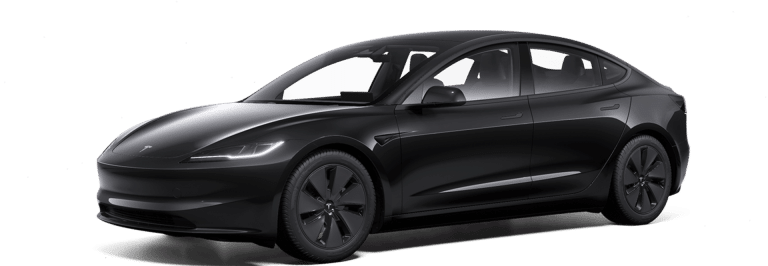
Tesla Model Y
Despite its familiar format, it scored very well thanks to :
- to highly optimised production,
- exceptional efficiency,
- very low-carbon industrial processes.
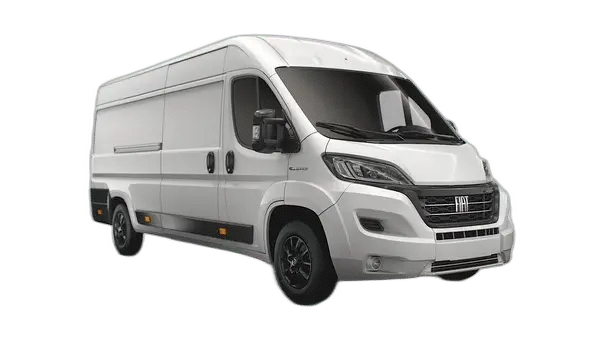
Recent light commercial vehicles
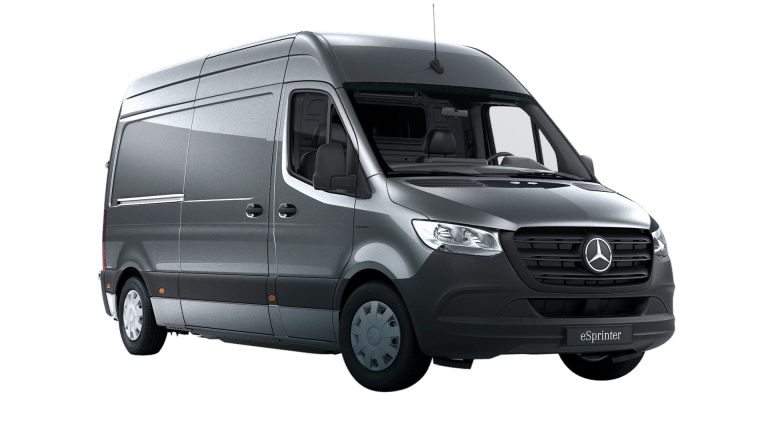
Several electric LCVs designed to new standards are scoring well, opening up new prospects for technical and logistics fleets.
These models have one thing in common: they combine reduced environmental impact, high efficiency and more controlled running costs.
Penalised vehicles and why it matters to businesses
Some electric models have a low eco-score, not for reasons of use, but because of their design or manufacture. Vehicles produced in carbon-intensive countries, fitted with very large batteries or transported over long distances all have a worse environmental record. Weight also plays an important role: the heavier a vehicle is, the greater its carbon impact during manufacture, and the worse its energy efficiency.
As a result, models that are commercially attractive are becoming less compatible with companies' environmental and financial requirements.
For companies, this means :
- loss of the bonus, and therefore a mechanically higher TCO ;
- a risk of unavailability in long-term hire offers,
some rental companies reject models with poor ratings; - poorer CSR performance, a criterion now included in CSRD audits.
A poorly rated model is sometimes difficult to integrate into a long-term fleet strategy.
Eco-score and fleets: what impact on TCO, leasing and LEZ strategy?
The introduction of the eco-score is changing the face of total cost of ownership. Companies can no longer think solely in terms of catalogue prices or autonomy: the eco-score influences rents, residual values and access to bonuses.
Potentially lower rents
Top-rated vehicles :
- benefit from the ecological bonus,
- are valued by rental companies,
- are often more energy efficient,
- cost less to produce and recycle.
As a result, their long-term hire leases are becoming more competitive.
Conversely, a poorly-rated vehicle can lose up to several thousand euros in bonuses, which immediately translates into higher monthly payments.
When the environmental bonus has a direct impact on TCO
Since the reform of the bonus, the eco-score determines :
- eligibility for the bonus,
its amount, - incorporating this bonus into rental solutions.
For a company, the difference in eco-score can generate a significant difference in TCO over 36 or 48 months. In many scenarios, a better-rated model becomes more economical, even if it is more expensive to buy.
With finance departments now including this parameter in their analyses, the eco-score is becoming as much an economic criterion as an environmental one.
What opportunities are there for optimising your automotive policy?
The eco-score is forcing companies to rethink their automotive strategy in a more structured and sustainable way. This new tool can become a powerful lever for reducing costs, improving CSR image and securing regulatory compliance.
Rethinking car policy on the scale of the environmental score
A modern car policy must incorporate :
- a minimum score for new models,
- classification by segmentation (urban, compact, SUV, LCV),
- energy efficiency,
- allocation rules aligned with real needs.
This avoids the use of oversized and poorly rated models, which increase costs and reduce the carbon footprint.
Better dimensioning of vehicles according to actual use
The eco-score favours efficient models:
- more compact battery,
- lower consumption,
- more rational design.
Companies can take advantage of this development to realign their vehicles with their real missions: city cars for urban technicians, compact cars for regional sales staff, optimised LCVs for touring.
This resizing often makes it possible to reduce both TCO and carbon impact.
What managers need to anticipate for 2026
Environmental regulations will not remain static in their current form. The assessment criteria will continue to be tightened, particularly with regard to the traceability of materials, the carbon impact of transport, the second life of batteries and real performance over the complete vehicle cycle.
For fleets, this means that they need to start preparing for future developments now, or risk ending up with less eligible or less competitive models.
The risk of dependence on certain higher-rated models
As only certain models are highly rated, the market is likely to concentrate around them:
- tension on deadlines,
- potential rise in prices if demand exceeds supply,
- over-reliance on 3 or 4 models.
Managers need to think ahead by building :
- a diversified selection,
- several alternatives per segment,
- ongoing analysis of score updates.
How to secure your choices in the face of changing regulations
The calculation methodology is set to become stricter. Companies therefore need to be vigilant about the regulations:
- check the ecoscores regularly,
- adjust the car policy in real time,
- provide for B options if a score deteriorates,
- Incorporate ecoscore into calls for tender for long-term leasing.
The aim is to avoid integrating a model that becomes non-compliant or ineligible the following year.
Worth remembering: the eco-score redefines fleet purchasing priorities
Ecoscore is not a passing trend: it is a structuring tool that influences TCO, purchasing strategy, CSR and regulatory compliance.
To remember:
- The best-rated models are often the most suitable for fleets.
- Ecoscore has a direct impact on bonuses, rents and residual values.
- Car policies must include a minimum score threshold.
- Companies must avoid dependence on a few highly rated models.
- Mastering the ecoscore is becoming a key skill for fleet managers.
Organisations that quickly incorporate this new indicator into their strategy will have a major economic, environmental and operational advantage over the period 2025-2030.
Manage your fleet easily with our dedicated tool

A fleet management tool from A to Z
- Add your fleet and employees in just a few clicks
- Plan your transition to electric vehicles and monitor your CSR objectives in real time
- Centralise your expenses