






Design: Sporty elegance meets practicality
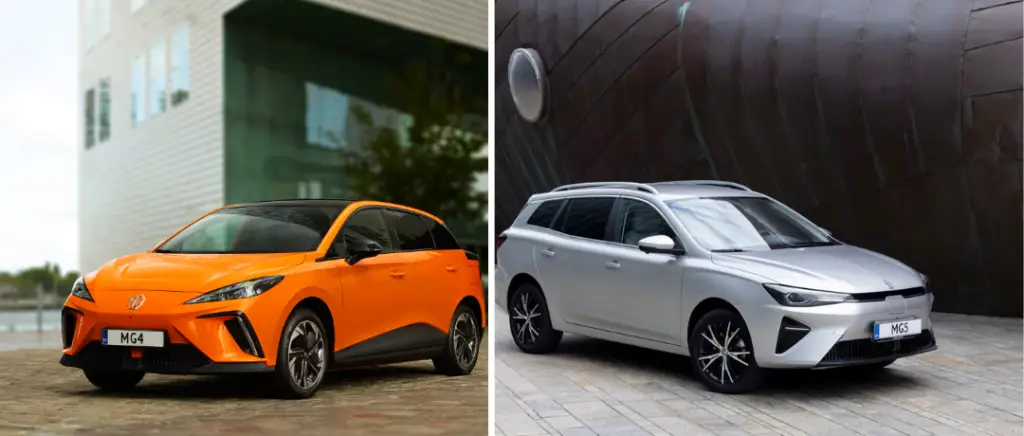
Design plays a crucial role in the MG4 vs MG5 battle. The MG4 stands out for its resolutely modern and sporty look. At 4.29 metres long, it boasts an aggressive bonnet and a striking light signature that catch the eye. The flowing lines and bold colours of this electric car make it an attractive choice for drivers looking for a contemporary look.
By contrast, the MG5, as an electric estate car, is more about functionality than looks. Measuring 4.60 metres in length, its lines are more classic and conventional. Although less flashy than its cousin, the MG5 meets the needs of drivers who value practicality, particularly for professional use or as a fleet vehicle.
The boot volume is a perfect illustration of this difference in approach. The MG4 offers 363 litres of load space, while the MG5 offers a generous 479 litres, or 32% more. This increased capacity makes the MG5 a wise choice for those who need extra load space, whether for personal or professional use.
Ultimately, the choice between these two models will largely depend on the buyer's priorities: the sporty elegance of the MG4 or the assertive practicality of the MG5. These aesthetic and functional differences can also influence leasing options, both for private individuals and for professionals considering incorporating these vehicles into their fleet. vehicle fleet.
Take a look at the video highlights of the MG4 and MG5 to get a better idea of their differences before going into the details of this comparison.
Space and boot: On-board space and load volume
The MG5 and MG4 offer different experiences in terms of habitability and load capacity. The MG5, being an estate car, naturally offers advantages in terms of space. It boasts an impressive boot volume of 479 litres, expandable to 1,367 litres when the rear seats are folded down. This generous volume puts it well ahead of rivals such as the Kia e-Niro.
The MG4, on the other hand, although more compact, offers surprising interior space for its size. Its boot capacity of 363 litres is admittedly more modest than that of the MG5, but is still quite adequate for a car in this segment. The MG4 makes up for this difference with a more judicious interior layout, offering generous space for both front and rear passengers.
It is important to note a few specific points:
- Despite its large boot space, the MG5 does have one drawback: the floor is not flat when the rear seats are folded down, which can limit practicality for certain loads.
- The MG4, although smaller, benefits from a lower floor, offering greater comfort for taller passengers on long journeys.
- The MG5's centre console is described as imposing, which can reduce the impression of space at the front.
In conclusion, if load volume is your absolute priority, the MG5 will be the obvious choice. However, for those who prefer a well thought-out interior space and don't need an oversized boot, the MG4 could prove to be a more balanced option.
On-board technologies: Connected and assisted
The MG4 and MG5 are distinguished by their similar technological offerings, reflecting MG's commitment to offering modern, well-equipped electric vehicles. Both models feature comprehensive infotainment systems, including Apple CarPlay and Android Auto, ensuring optimum connectivity for drivers. The user interface is centred around a 10.25-inch touchscreen, providing a high-quality visual and interactive experience.
In terms of driver assistance, both vehicles are equipped with Level 2 systems, including :
- Adaptive cruise control
- A lane-keeping system
Although these technologies can be improved in terms of performance, they are remarkably present right from the entry level of the MG4, a rare asset in this category of vehicle.
The interior layout of both models is designed around two screens: one for the instrumentation behind the steering wheel, and a central one dedicated to infotainment. This layout, which has become standard in the automotive industry, offers appreciable ergonomics and easy access to essential information.
It is important to note that despite these technological similarities, the newer MG4 benefits from the SAIC Group's latest Modular Scalable Platform (MSP). This more modern technical base could potentially offer easier future upgrades and enhancements, although this advantage is not immediately apparent in the current offering.
Driving experience: dynamic and comfortable
The driving experience differs significantly between the MG4 and MG5, each offering its own advantages. The more compact MG4 stands out for its agility and dynamic performance. It accelerates from 0 to 100 km/h in just 7.7 seconds, outperforming the MG5 which does the same in 8.3 seconds. This agility is particularly noticeable on winding roads, where the MG4 excels thanks to its smaller size and better handling.
On the other hand, the MG5 favours comfort on long journeys, although certain aspects of its ride can be improved. Its softer suspension ensures a smooth ride, but leads to more pronounced roll when cornering. What's more, the driving position in the MG5 can be less comfortable for tall people, due to the relatively high floor.
In terms of fuel consumption, the MG4 is more efficient, averaging around 18 kWh per 100 km, compared with 20 kWh/100 km for the MG5. This difference translates into a autonomy more important for MG4, despite its greater battery of similar capacity.
It's worth noting that neither the MG4 nor the MG5 offer single-pedal driving, a feature appreciated on some electric vehicles. The regenerative braking is present on both models, but its effect remains limited.
To get a better idea of the MG4's performance and roadholding, take a look at this video presentation, which illustrates its dynamism in action:
Engines and performance: Power and range
The MG4 and MG5 have distinct powertrain configurations, reflecting their different positions in the electric vehicle market. The more recent and technologically advanced MG4 offers more powerful options and a longer range.
The MG4 is available in several versions:
- A 170 bhp engine with a 51 kWh battery, offering a WLTP range of 350 km
- A more powerful 203 bhp version, equipped with a 64 kWh battery, offering a WLTP range of 450 km.
- A top-of-the-range variant with a 77 kWh battery, capable of 520 km of WLTP range
In comparison, the MG5 offers less varied options:
- A 130 kW (177 bhp) "Standard Range" version with a 50 kWh battery, for a WLTP range of 320 km
- A 115 kW (156 bhp) Extended Range version with a 61 kWh battery, offering 400 km of WLTP range
In terms of performance, the MG4 stands out, accelerating from 0 to 100 km/h in 7.7 seconds for the base version, compared with 8.3 seconds for the MG5.1. This difference underlines the MG4's superior agility, despite its more compact size.
Importantly, MG plans to replace the current MG5 with a new model based on the MG4 platform. This future electric estate should benefit from a significant increase in power and range, with potentially 245 bhp and a 77 kWh battery, closing the current gap between the two models.
Batteries and recharging: Capacities and charging speeds
The MG4 and MG5 offer distinct battery and charging options, reflecting their respective positions in the electric vehicle market. The MG4 stands out with a wider range of battery options, offering capacities of 51, 64 and 77 kWh. The latter option, available on the latest version, gives the MG4 an impressive range of up to 520 kilometres.
In comparison, the MG5 offers two battery configurations: 50 kWh for a range of 320 km, and 61 kWh for up to 400 km.
In terms of recharging, the two models offer similar performance. The MG4 equipped with the 64 kWh battery can recharge from 10 to 80% in 35 to 40 minutes on a fast charge. The MG5 has comparable recharge times, requiring around 40 minutes to reach 80% of charge. Both vehicles are also compatible with AC charging, with the MG4 benefiting from an on-board 11 kW charger with the 64 kWh battery, enabling a full charge in approximately seven hours.
It is important to note that the MG4, thanks to its more recent and diverse range of batteries, generally offers better fuel efficiency. In tests, the MG4 consumed around 18 kWh per 100 km, while the MG5 consumed slightly more, at around 20 kWh/100 km.
Prices and equipment : Accessibility and options
The MG4 and MG5 are positioned differently in terms of price and equipment, reflecting their respective segments and target uses. Here's an overview of the key points to consider:
Admission prices
- MG4: The compact electric car starts at a very competitive price of €21,990 thanks to recent promotions, well below its initial list price of €29,990 for the Standard version equipped with a 51 kWh battery.
- MG5: The electric estate is more expensive, with a starting price of €32,990, excluding the environmental bonus. Versions with a Long Range battery (61 kWh) start at €35,990, and top-of-the-range models can fetch up to €38,140 with options included.
Standard equipment
- Both models offer similar technological features, including :
- A central 10.25-inch touchscreen.
- Semi-autonomous driving assistance systems (level 2), such as adaptive cruise control and lane keeping assist.
- The MG4 features a more modern approach, with recently updated equipment for the 2025 model, such as additional active safety features.
Options and finishes
- The top-of-the-range versions of the MG4 offer extended range (up to 450 km WLTP) and sporty finishes such as the XPOWER variant, ideal for fans of enhanced performance.
- As a family estate, the MG5 places greater emphasis on practicality, with a more generous boot space. However, it is still limited in terms of technological options compared with its compact rival.
If affordability and modern equipment are your priorities, the MG4 is unbeatable. On the other hand, for those who prefer the space and versatility of an electric estate, the MG5 remains an interesting option, albeit less competitive in financial terms.
Value for money
- The MG4 stands out as an economical choice thanks to its significant discounts and excellent value for money. It is particularly aimed at urban buyers or those looking for an affordable but well-equipped electric car.
- Despite its higher price tag, the MG5 appeals to families and professionals who need a spacious vehicle. However, its higher cost may be an obstacle for some consumers.
Verdict: Which electric MG to choose?
After an in-depth analysis, the MG4 emerges as the wisest choice for the majority of buyers. This compact electric car outperforms the MG5 in a number of crucial respects:
- Performance: The MG4 offers better acceleration, reaching 100 km/h in 7.7 seconds compared with 8.3 seconds for the MG5.
- Range: With a WLTP range of up to 450 km, the MG4 is ahead of the MG5, which has a maximum range of 400 km.
- Agility: Its more compact size and improved roadholding make it easier to handle, particularly in urban environments.
- Value for money: Priced from 29,990 euros, the MG4 is more affordable than the MG5, which starts at 32,990 euros.
However, the MG5 retains an advantage in terms of load volume, offering 479 litres compared with 363 litres for the MG4. However, this advantage is mitigated by the absence of a flat floor when the seats are folded down.
It's worth noting that MG plans to replace the current MG5 with an estate version of the MG4 in 2024, which is expected to offer an extra 70bhp of power and an extra 100km of range. This development could redefine the choice between these two models in the near future.
Summary table
| Category | MG4 | MG5 |
|---|---|---|
| Design | Modern, sporty looks, flowing lines and bold colours. | Classic, functional design with a focus on practicality. |
| Length | 4.29 metres | 4.60 metres |
| Safe | 363 litres | 479 litres (32% more than the MG4), extendable to 1,367 litres. |
| Habitability | Well-designed interior space, low floor for greater comfort. | Generous space, but the floor is not flat when the seats are folded down. |
| Technologies | 10.25-inch touchscreen, Apple CarPlay, Android Auto, level 2 driver assistance. | Same technologies as the MG4, but less modern. |
| Engines | 170 bhp (51 kWh), 203 bhp (64 kWh), 77 kWh (520 km WLTP range). | 177 bhp (50 kWh), 156 bhp (61 kWh), WLTP range of up to 400 km. |
| Performance | 0 to 100 km/h in 7.7 seconds. | 0 to 100 km/h in 8.3 seconds. |
| Consumption | Around 18 kWh/100 km. | Around 20 kWh/100 km. |
| Batteries and recharging | 51, 64 and 77 kWh batteries. Fast recharge: 10-80% in 35-40 min. | 50 and 61 kWh batteries. Fast recharge: 10-80% in 40 min. |
| Prices | From €21,990 (special offer) or €29,990 (standard version). | From €32,990 (excluding environmental bonus). |
| Value for money | Excellent value for money, urban and economical target. | More expensive, targeting families and professionals for the space. |
| Verdict | Optimum choice for performance, autonomy, agility and price. | Choice for those who prefer space, but less competitive. |
Conclusion
In conclusion, the MG4 is the wisest choice for the majority of electric vehicle buyers. It outperforms the MG5 in terms of performance, range, agility and value for money. With faster acceleration, a WLTP range of up to 450km, and a more attractive starting price, the MG4 offers a superior value proposition. Although the MG5 retains an advantage in terms of load volume, this is mitigated by a number of practical drawbacks.
However, it is important to note that MG plans to replace the current MG5 with an estate version of the MG4 in 2024, which could redefine the comparison between these two models. For now, the MG4 remains the optimal choice for those looking for a powerful, economical and well-equipped electric car.
Do you want to go electric? Beev can help you make the transition to greener, more sustainable mobility. Whether you're an individual looking for a installation of home charging points or a professional requiring installation of recharging points for professionalswe are simplifying theinstallation of a recharging pointby offering you tailor-made solutions to meet your specific needs. So go ahead, install a charging point and set yourself apart from the competition.