

















What the new Model 3 Standard 2026 really changes
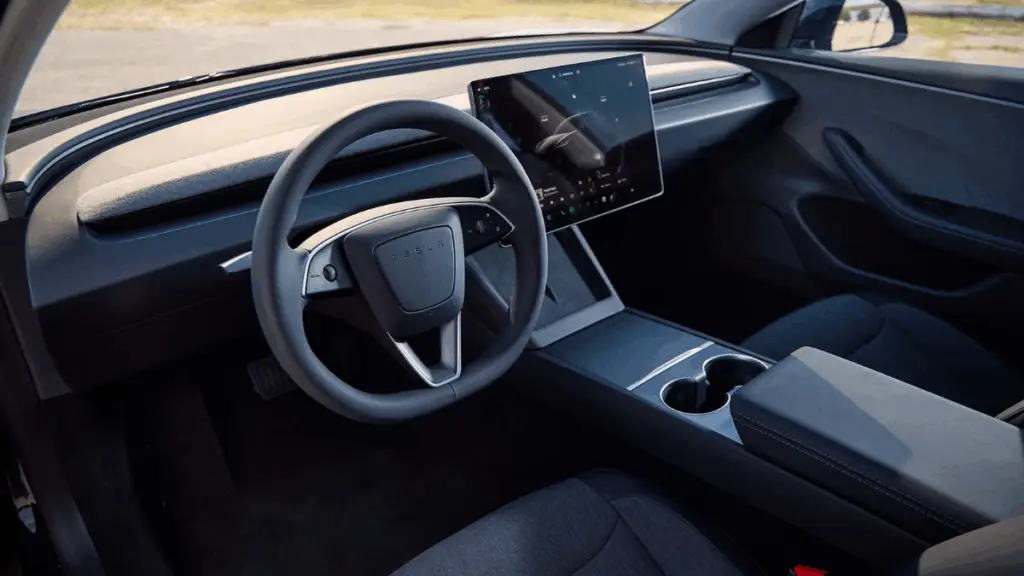
The Model 3 Standard 2026 is not just a simple update. It represents a strategic evolution, designed to respond to an increasingly professional market. Tesla has reworked the design, architecture battery, price positioning and energy efficiency to offer a more affordable but still highly technological saloon.
Here's what you need to remember.
A modernised design
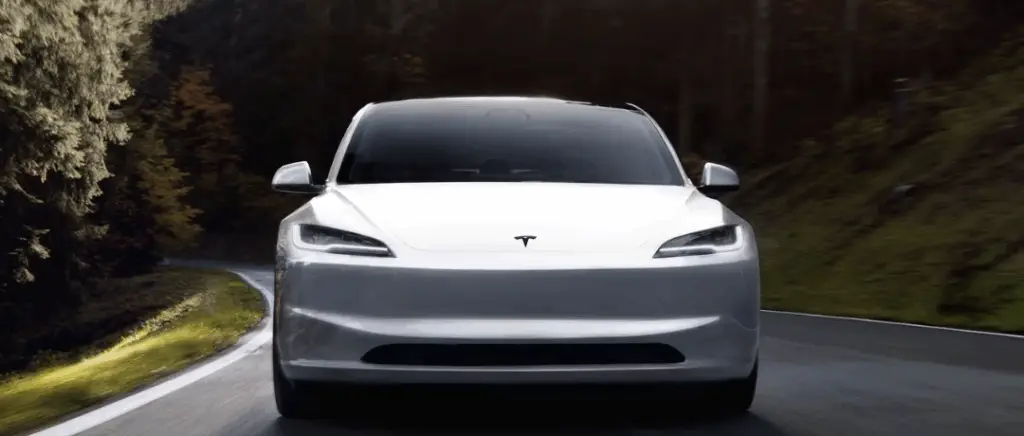
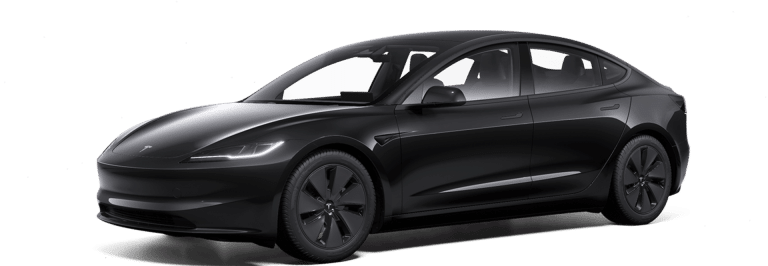
The 2026 restyling of the Model 3 Standard uses the same architecture as the Highland, but with a few adjustments.
The silhouette remains true to Tesla's style, with flowing lines and a sleek profile. aerodynamics and minimalist design. But this version boasts a sleeker front end and a refined light signature, reinforcing its identity as a modern, efficient saloon.
The identity retains the “all-screen” bias that characterises the brand, while introducing a more sober ambience. Ergonomics have evolved slightly to reduce costs without compromising comfort: simplified materials, optimised layout, and the reduction of a few premium elements to encourage an increase in volume without a price explosion.
For fleets, this streamlined interior is an advantage: less complexity, fewer wearing parts, and therefore lower maintenance costs excluding tyres and consumables.
A more affordable version: what Tesla has done to cut costs
Tesla's objective with this Model 3 Standard 2026 is clear: become the most affordable Tesla ever offered in Europe.
To reach an unprecedented entry price of 36 990 €, Tesla has made a number of adjustments:
- simplification of certain materials and finishes ;
- more rational but still modern equipment; ;
- battery with more controlled chemistry in terms of costs ;
- industrial optimisation to speed up production rates.
The approach is similar to what Tesla applies when it wants to democratise a model: maintain the technological DNA, but reduce the superfluous.
For businesses, this means a much more competitive acquisition price, which is a key condition for mass deployment in a fleet.
Performance, autonomy and battery: what is this Model 3 Standard 2026 really worth?
Despite its more economical positioning, the standard Model 3 2026 remains true to Tesla's reputation: efficient, responsive and perfectly suited to intensive daily use.
The information available indicates :
- a LFP (lithium-iron-phosphate) battery optimised, ideal for frequent recharging to 100 % ;
- a realistic autonomy estimated at around 350 to 390 km over a combined cycle, depending on rims and driving style ;
- a sufficient engine power to ensure good recovery, even on motorways; ;
- a behaviour perfectly suited to long days business travel.
Here, LFP chemistry is an advantage for fleets, as it withstands repeated cycles better, reduces the risk of accelerated degradation and simplifies refill management.
Charging, network and energy efficiency: a model designed for everyday use
Naturally, one of the major advantages is access to the Supercharger network, one of the most reliable in Europe. Coupled with very low fuel consumption (thanks to aerodynamic work and the new engine/battery calibration), the vehicle becomes particularly relevant for intensive use.
The Model 3 Standard 2026 enables :
- a DC fast recharge high performance (allowing several hundred kilometres to be recovered quickly); ;
- a AC load 11 kW perfectly suited to corporate deposits; ;
- a very stable energy management, even in winter; ;
- a ultra-competitive cost per kilometre thanks to its efficiency.
For fleets travelling between 80 and 250 km per day, it more than covers all requirements without any reorganisation of operational planning.
Tesla's new pricing strategy and its impact on fleets
Tesla has been following the same logic for several years: increase volumes, standardise costs and make its vehicles more competitive for professionals.
The Model 3 Standard 2026 embodies this strategy in its clearest form.
An entry-level price unprecedented in the Tesla range
This version is the most affordable Tesla in the European catalogue. This is a radical change for businesses.
While the Model 3 Long Range and Performance were in the premium segment, the Standard 2026 version is priced on a par with many of the top-of-the-range internal combustion hatchbacks still found in business fleets.
For the first time, this positioning means that medium-sized or multi-trade fleets can consider Tesla as part of their electrification strategy.
TCO: significantly lower costs for businesses
Total Cost of Ownership is the main decision-making criterion for fleets.
In this respect, the Model 3 Standard 2026 marks a turning point:
- very inexpensive energy The cost per km is up to 60 % lower than a combustion engine; ;
- reduced maintenance No oil changes, no belts, few moving parts; ;
- excellent residual value, even on Standard versions; ;
- no TVS and very advantageous taxation ;
- ideal LFP battery for intensive professional use.
For managers, this means a more predictable TCO, lower and more stable over 4 to 5 years.
Tesla Model 3 Standard 2026: what are the concrete benefits for fleet managers?
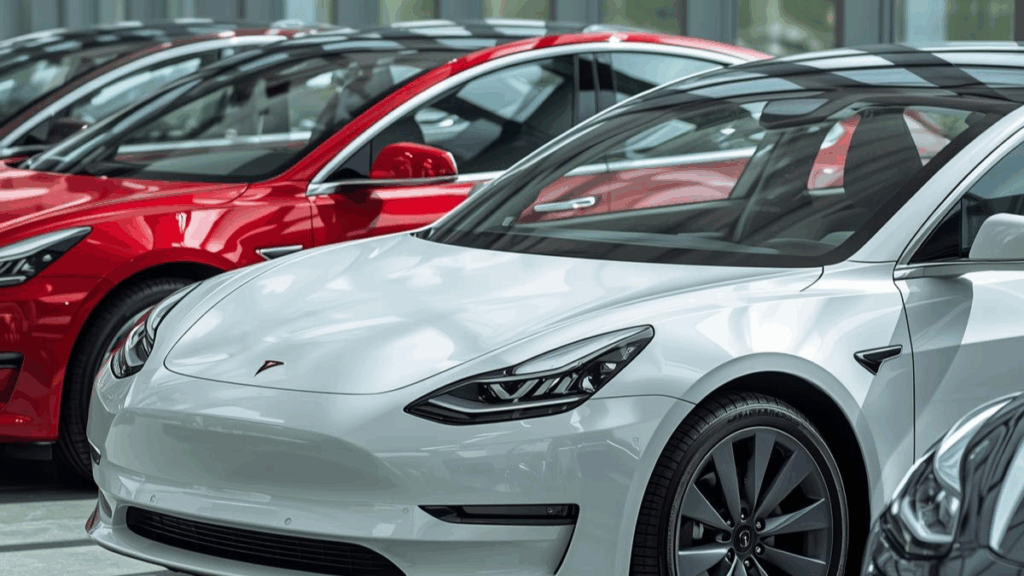
The key question is simple: what does this version really offer businesses?
The benefits are numerous and very tangible.
Suitable for everyday use
Most company drivers cover between 80 and 220 km a day. The Model 3 Standard 2026 covers this range with a comfortable range and controlled fuel consumption.
It fits perfectly into a fleet:
- sales team ;
- consultants ;
- multi-site managers ;
- Light technicians ;
- pool vehicles.
Its range/price balance makes it one of the most rational vehicles on the market.
An attractive car for recruiting and building loyalty: premium image, comfort, digitalization
Companies today need to attract and retain talent. Offering a Tesla vehicle remains a concrete advantage in a salary package.
Interior comfort, connectivity, an innovative image and ease of use all contribute to greater employee satisfaction.
Feedback from fleets proves it: Tesla vehicles are among the best rated by professional drivers.
A regulatory advantage: EPZ compliance, CSR objectives and CSRD reporting
With the tightening of Low Emission Zones, choosing a zero-emission vehicle is becoming essential to ensure sustainable access to city centres. The Model 3 Standard 2026 responds perfectly to this challenge, ensuring unrestricted mobility that complies with regulations over the long term.
It is also an immediate lever for improving CSR indicators emissions: its zero local emissions help to reduce the’carbon footprint of the fleet and more easily feed into internal decarbonisation objectives. Last but not least, thanks to its accurately reported consumption and usage data, it fits in naturally with CSRD reporting, providing companies with a reliable tool for documenting their environmental performance.
Use the TCO simulator to calculate the total cost of ownership of your car and compare it with its internal combustion equivalent.
2026 comparison: Model 3 Standard and Tesla range
To help fleets choose between the different versions, here's a simplified comparison that positions the Standard 2026 against the other models in the range: range, uses, economic relevance.
| Criteria Element compared | Model 3 Standard (2026) Entry-level | Model 3 Long Range Long Range | Model 3 Performance Sport version | Model Y Propulsion Compact SUV | Model Y Long Range Long autonomy |
|---|---|---|---|---|---|
| Autonomy | ~350-390 km | ~530 km | ~510 km | ~430 km | ~540 km |
| Battery | LFP | High-efficiency NMC | NMC performance | LFP | NMC |
| Prices | The most accessible | More expensive | Top of the range | Accessible SUV | Higher |
| Ideal use | Daily fleets | Long regular journeys | Performance priority | Family teams / equipment | Intensive multi-sites |
| TCO | Excellent | Very good | Higher | Very good | Good |
How can the Tesla Model 3 Standard 2026 be integrated into a business fleet?
Successful electrification is based on method and anticipation.
Here are the key steps for effectively integrating the Model 3 Standard into a professional fleet.
Stage 1: analysing usage and identifying suitable profiles
Before making any decisions, we need to map usage: daily mileage, types of journey, parking times, access to sites, specific business needs.
This analysis validates that the Model 3 Standard corresponds to real-life journeys, which is the case for the vast majority of light commercial and technical fleets.
Step 2: prepare the’recharging infrastructure
Recharging is a key factor in the success of an electric vehicle project.
To integrate the Model 3 Standard, the company must plan :
- AC 11 kW overnight charging ;
- access to the public network for interregional travel ;
- smart-charging to avoid energy peaks; ;
- centralised supervision via software.
A well-designed infrastructure improves availability and optimises TCO.
Stage 3: Deploy, train and monitor TCO and CO₂ indicators.
Once the vehicles are in service, training is essential: recharging management, eco-driving, good autonomy practices.
The manager then follows:
- actual consumption ;
- costs per km ;
- changes in avoided CO₂ ;
- driver satisfaction.
These indicators can be used to adjust the car policy and maximise the benefits of the electricity transition.
To remember
With the Model 3 Standard 2026, Tesla is once again turning the professional market on its head. For the first time, a Tesla saloon will be truly affordable, at €36,990, available from February 2026, without compromising on performance, range or energy efficiency.
This model combines everything today's fleet managers are looking for:
perfectly calibrated range for daily journeys, fast charging, one of the most competitive TCOs on the market, an attractive employer image and full compliance with the EPZs and CSR requirements.
So for businesses, the question is no longer whether the Model 3 Standard 2026 is relevant, but rather: When should it be incorporated into the 2026-2027 transition plan to maximise operational and financial gains?
Beev supports professionals at every stage: analysis of usage, fleet sizing, choice of model, financing, installation of recharging systems and deployment
Manage your fleet easily with our dedicated tool
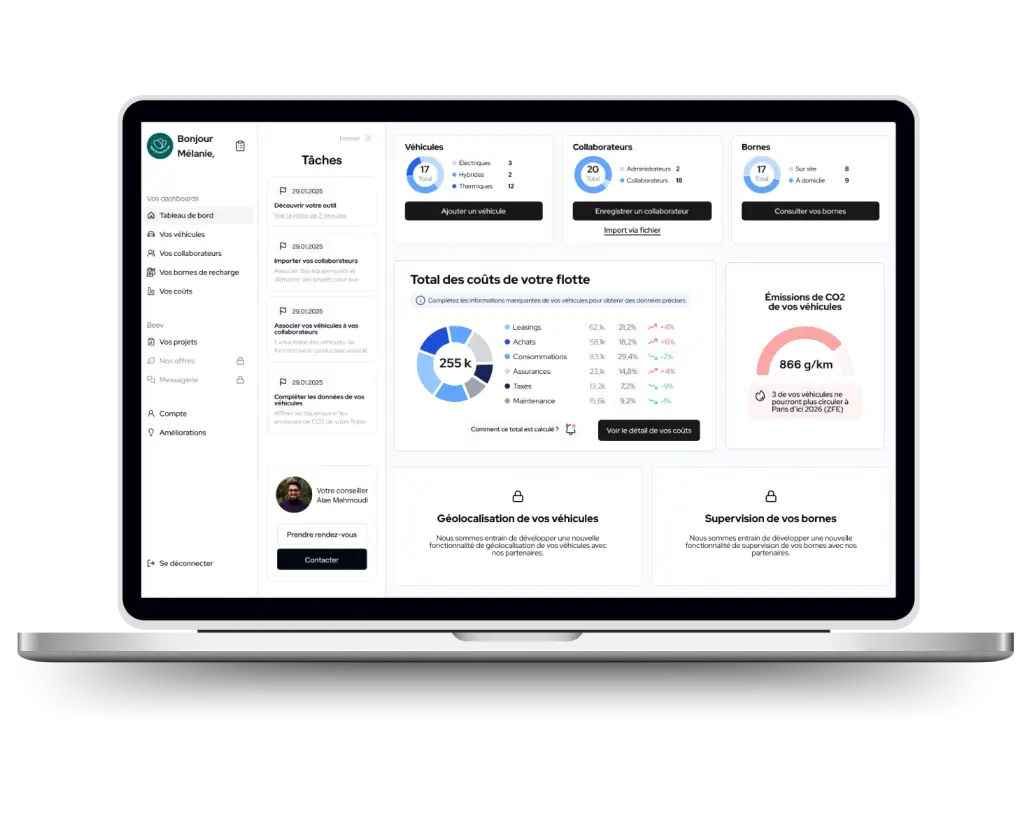
A fleet management tool from A to Z
- Add your fleet and employees in just a few clicks
- Plan your transition to electric vehicles and monitor your CSR objectives in real time
- Centralise your expenses