




What are the differences between an internal combustion engine car and an electric car?
Before looking at the advantages and disadvantages of taking your driving test with an electric car, it's important to know the differences between a combustion engine car and an electric car.
At first glance, an electric car generally looks like any other vehicle. To see the differences, you need to look under the bonnet and under the floor.
Instead of an internal combustion engine using heat as energy, it uses electricity. To understand step-by-step how an electric car works and to know how to tell the difference between a combustion engine car and an electric car, here are a few points of difference.
Recharging
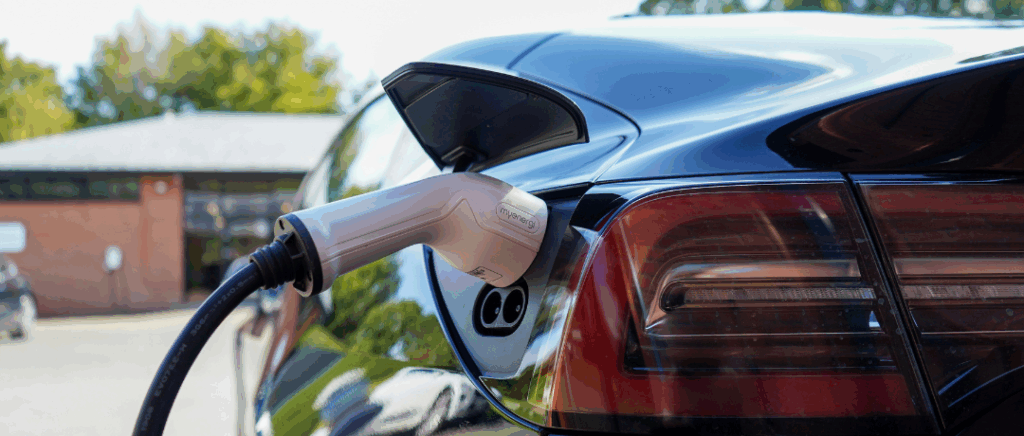
Let's start with recharging. To refuel, an electric car needs to be plugged into a socket or charging point. This is done using a cable fitted with appropriate connectors. There are several of these, corresponding to the desired charging mode.
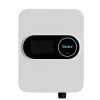
The converter
It can transform alternating current from the grid into direct current (DC). Batteries can only store energy in the form of direct current. To avoid this step and recharge more quickly, some charging points convert the electricity themselves, injecting direct current directly into the battery. battery. These are the so-called «fast» and «ultra-fast» DC charging points, like those found at motorway service stations.
The battery
The electric vehicle essentially comprises a battery system that acts as both the fuel and the electric motor. It differs from thermal vehicle by the fact that it takes longer to recharge and is easier to transport and distribute electricity than a combustion-powered vehicle. The car is generally equipped with one or more electric motors whose total power can range from 15 to over 400 kW. kW, depending on the size of the vehicle, its use and the performance required.
Gearbox
La electric car has no gearbox. There is no need for a gearbox, because an electric motor is capable of operating at up to several tens of thousands of revolutions per minute without any problem. It supplies the rotation directly, unlike a combustion engine, which has to convert the rectilinear motion of the pistons into circular motion. Logically, there are far fewer moving parts in an electric car than in a combustion engine vehicle.
One of the key advantages of electric cars is the generation of electricity for battery-powered vehicles. In fact, when an electric motor runs «in a vacuum» without being supplied with current, it generates electricity. This happens every time you take your foot off the accelerator pedal or apply the brakes. The energy recovered is fed directly into the battery.
Where can I take my electric car driving test?
With over 1,506,573 users, Ornikar has become the new way to take your driving test, and it costs 35 % less than a traditional driving school. Don't hesitate any longer and book your driving lessons directly at Ornikar website.
You don't have your driving licence and you want to take your driving test? Ornikar also has you in mind. Start practising now on free code series.
You can also take your exam as an independent candidate with Ornikar.
Monday to Friday 9am - 12.30pm - 2pm - 7pm
What are the advantages and disadvantages of taking an electric driving test?
Now that you know almost everything about electric cars, let's talk about driving licences. Taking your driving test in an electric car offers a number of advantages, not only for trainees but also for driving schools.
Benefits
Increased confidence : A number of driving schools that have an electric car in their fleet start training candidates on such a vehicle. This enables the learner to master certain driving techniques and gain greater confidence. After the first few hours, the trainee can switch to a manual gearbox to learn how to shift gears, having already acquired certain reflexes and confidence.
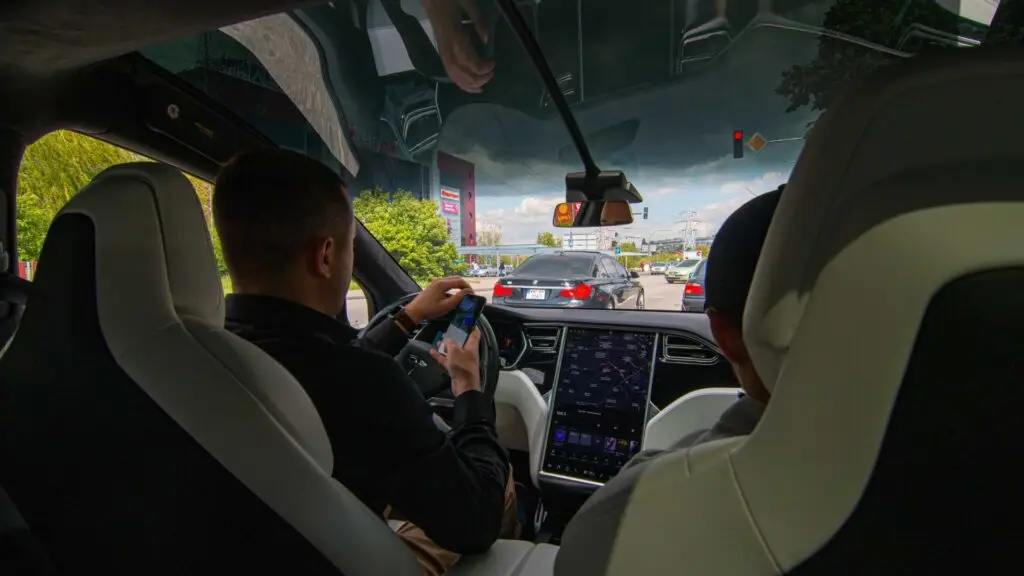
Simple handling : the The main advantage of learning to drive an electric car is the simplicity of the learning process, which is achieved by making it easy to get to grips with. The learner doesn't have to worry about shifting gears and just has to focus on the environment. What's more, acceleration and braking on an electric car are much smoother and easier to control. What's more, hill starts, which are often problematic for beginners, are no longer a worry.
Faster delivery: it's also quicker to obtain your licence, with only 13 hours of driving required compared with 20 hours for the standard B licence.
Lower costs for both sides: Taking your driving test on an electric car is a cheaper solution than a conventional driving test. It only takes 13 hours to learn. And for the driving school, the costs are also lower. Electric cars cost considerably less to recharge (2 per 100 km compared to €8.50 for a diesel model) but also to maintenance.
A pleasure for the instructors: There are also advantages for instructors, as an electric car is much quieter and easier to teach, so the trainer only has to concentrate on the environment, safety and traffic.
Disadvantages
Limitation on the licence : As you know, electric cars do not have a mechanical gearbox. As a result, candidates will only be able to obtain a B licence with an automatic clutch (BEA), effectively limiting their right to drive only vehicles fitted with an automatic gearbox. It is therefore impossible to drive a vehicle with a manual gearbox. A limitation that may make some people think twice before embarking on the electric adventure.
Who should take their driving test in an electric car?
The fact that you only get a licence that allows you to drive cars with automatic gearboxes is obviously limiting. However, it is a very good option for many people.
Today, automatic gearboxes are winning over more and more motorists. After a difficult start, automatic gearboxes are gaining ground in France.
Our country was particularly recalcitrant to this type of transmission, which has been acclaimed the world over, starting with the United States, Japan and Asia in general. But for the last six or seven years, it has been a resounding success, and now equips 30 % of new cars sold.
The big advantage of automatic gearboxes is that you no longer have to worry about shifting gears. This may seem trivial to some, but it's an obvious gain in comfort, especially when you're on the move every day in traffic and city jams. For senior citizens or people with back problems, for example, it's much less tiring than having to change gears frequently.
Automatic gearboxes are also reassuring for drivers who are not always comfortable behind the wheel. They prevent you from stalling or shifting into the wrong gear. They also allow you to concentrate on driving and keep both hands on the wheel.
Will you be able to take a B driving licence at a later date?
However, anyone who has obtained their BEA licence on an electric car can subsequently convert it to a B licence. Conversion training is available after 6 months.
This additional training generally costs between €350 and €500, with a minimum of 7 hours' driving with an instructor to obtain your precious pass. This bridging course can be completed in just 2 days. The trainer will issue you with a certificate of achievement, which you can use to validate your B driving licence.
Good luck to you, and I'll see you on the road very soon, in electric vehicles of course!
Beev offers multi-brand 100% electric vehicles at the best prices, as well as recharging solutions.