















A technological advance that is revolutionising access to recharging for business travellers
Lorem ipsum dolor sit amet, consectetur adipiscing elit. Ut elit tellus, luctus nec ullamcorper mattis, pulvinar dapibus leo.
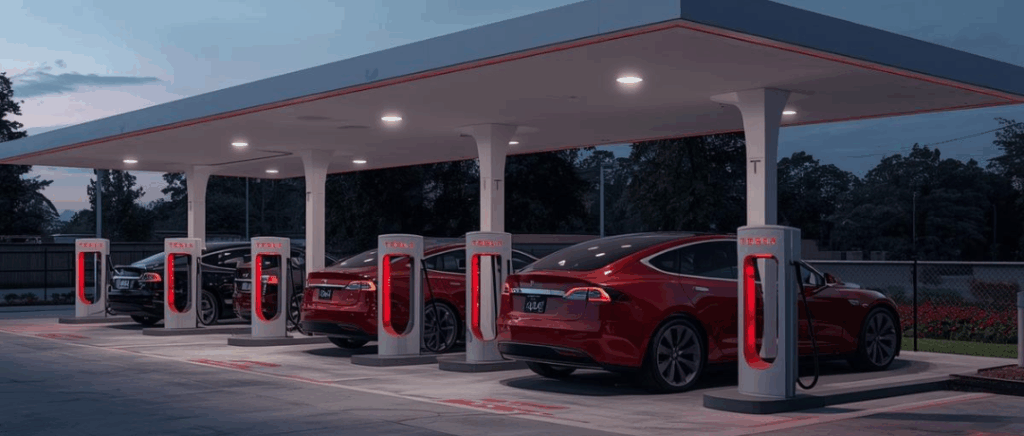
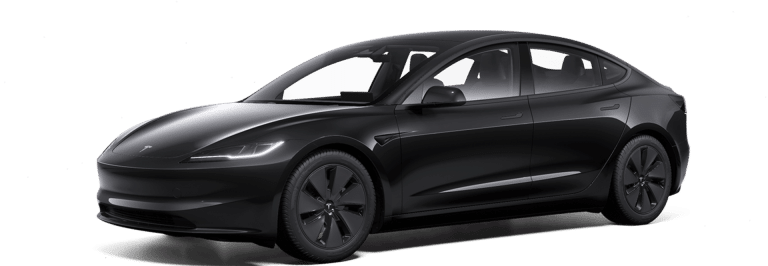
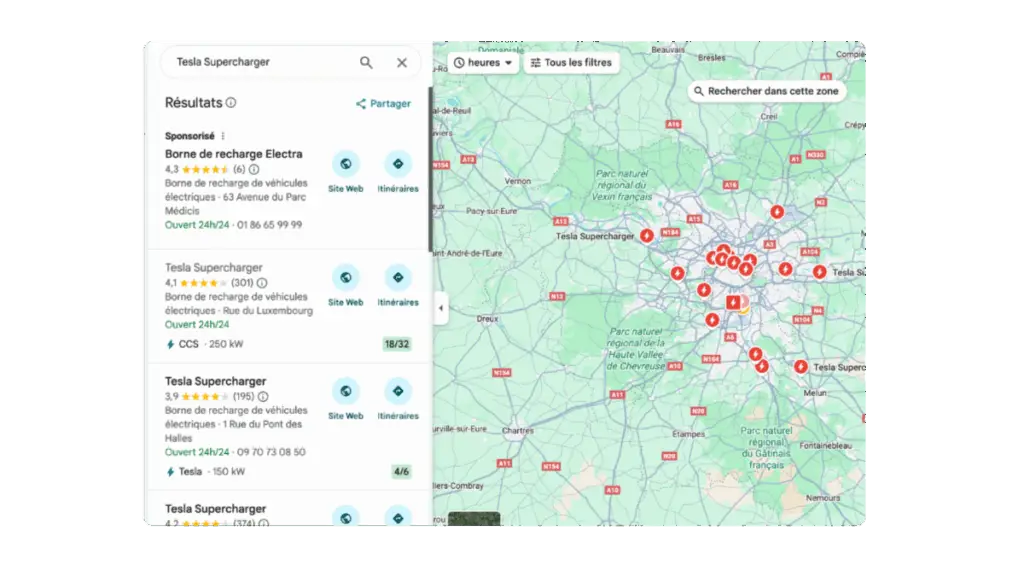
The integration of Superchargers into Google Maps is a major major turning point for the electric vehicle. Until now, charging networks have operated as parallel systems: Tesla on one side, other operators on the other, each with their own applications, their own data and their own standards.
From now on, one of the infrastructures the fastest and most reliable of the market can be seen in one of the the most widely used tools in the world by employees, managers and professionals on the move.
This fusion of information creates a unified, simple and predictable experience, something that has been sorely lacking in public charging, a key point for fleets looking to adopt electric vehicles on a massive scale.
A strategic change in the recharging ecosystem
This change alters the balance of the sector.
Tesla, historically closed, is becoming a transparent and interoperable player. Google, which already manages much of the world's navigation, is becoming a universal access point to the Internet.recharging infrastructure fast.
This convergence :
- brings together two technological standards widely used in the professional world;
- harmonises access to recharging information, which is essential for the widespread deployment of EVs;
- is the first step towards the expected standardisation of a market that is still highly fragmented, with proprietary applications and isolated networks.
This development is long overdue: public recharging must become as easy to understand as the service station network, otherwise fleets will continue to suffer unforeseen problems and additional costs.
For businesses, this standardisation is crucial: the simpler, more reliable and more consistent the access to recharging, the more electric vehicles become a viable option on a large scale, for both drivers and fleet managers.
Why Google is taking the plunge: industrial and technological issues
Google is not making this choice by chance.
The company is strengthening its position in three strategic areas:
1) Enhanced multimodal navigation (cars, terminals, traffic, energy).
2) Making the most of data mobility, a major asset for managers and manufacturers.
3) Controlling the ecosysteme of connected electric vehicles.
The aim is clear: to offer a single, coherent and comprehensive tool to replace the multiplicity of applications dedicated to recharging.
It's also a step towards the next generation of services: optimised itineraries based on charge levels, estimated energy costs for a journey, integration with corporate tools.
What this integration means for professional drivers
For employees who drive on a daily basis - sales staff, technicians, field teams and management - real-time visibility of Superchargers in Google Maps radically improves the electric driving experience.
We are moving from a fragmented system to immediate, centralised network visibility, in the tool they already use on a daily basis.
This fluidity not only reduces stress, but also wastes time... and therefore operational costs.
Smoother, more predictable journeys
An employee on a regional tour needs to be able to plan his or her refuelling without having to ask a thousand questions. Thanks to integration with Google Maps, they can now see :
- available Supercharger stations,
- the load power,
- the number of free terminals in real time,
- the exact distance from the charging point,
- the estimated recharge time according to power.
This information enables drivers to organise their refuelling stops with much less uncertainty, by integrating the break more easily into their daily schedule. The benefits are real: fewer unnecessary detours, less time wasted, fewer mission interruptions.
For companies where every hour counts - maintenance, construction, home services, sales force - this operational fluidity represents a tangible benefit.
However, it is important to note that Google Maps does not yet support the automatic addition of top-up stops to the itinerary. Drivers must always choose the most appropriate Supercharger manually.
But this advance does change the experience:
- recharging becomes visible, immediate and predictable;
- critical information is integrated directly into the tool used on a daily basis;
- and in vehicles equipped with Android Automotive, this data could rapidly enable intelligent itineraries that automatically integrate recharge stops.
In other words: planning is already more fluid, even if full automation is not yet here, but it's getting closer.
Fewer unforeseen events for electric vehicle fleet drivers
Before this integration, public recharging had a number of grey areas: charging points indicated as available when they were not, inaccessible stations, invisible queues, poorly-informed opening times, etc.
Google Maps corrects many of these problems by directly integrating Tesla data in real time, in particular the operating status and availability of the charging points.
In practical terms, this reduces three types of major hazard:
1) Out of order or out of service bollards not signalled in real time
2) Stations saturated at peak times
3) Unforeseen detours resulting in delays and additional costs
As a result, recharging becomes more predictable, which used to be a major brake on company car policies. An employee who knows that he or she will be available is a calmer and more efficient employee.
How this innovation is transforming centralised fleet management
Drivers gain peace of mind, but managers gain control.
Electric fleet management is based on the ability to accurately plan journeys, recharges and usage cycles.
The integration of Superchargers into Google Maps reinforces this capability.
More reliable planning of rounds, missions and interventions
The update profoundly changes the way fleet managers build routes.
Before :
Managers had to deal with fragmented data from third-party applications.
Today :
The most efficient network on the market is integrated into a unique navigation tool, improving logistical precision.
This consolidation enables :
- a more accurate estimate of journey times,
- simpler integration of top-up stops into the itinerary,
- better anticipation of constraints over long distances,
the possibility of correctly sizing theautonomy depending on the assignment.
For fleets spread over several sites or operating over large areas, this gain in precision is decisive.
More precise optimisation of resources: allocation, load planning, vehicle return, etc.
Visibility of the Superchargers also helps to improve the allocation of resources on a day-to-day basis: which vehicle to assign to which mission, how to organise recharging, how to avoid downtime.
Managers can :
- identify areas of high load availability,
- Intelligent distribution of vehicles according to autonomy requirements,
- optimise rotations (pool-cars, shared vehicles),
- reduce periods of inactivity caused by poorly planned recharging.
This operational optimisation has a direct impact on the electricity TCO, a major focus for finance departments.
Recharging becomes a lever for operational performance
With this development, recharging ceases to be a logistical constraint: it becomes a way of life. opportunity to improve the fleet's performance.
Companies equipped with electric vehicles benefit from greater overall efficiency, both in terms of consumption and organisation.
Rapid recharging: a direct lever for reducing downtime in electric fleets
Superchargers are among the fastest charging points on the market. Being able to identify them immediately via Google Maps means :
- reduce unnecessary or unplanned breaks,
- to avoid poorly located slow terminals,
- optimise recharge times according to the power available.
In businesses where time is a cost: breakdown services, delivery, sales forces; this reduction in downtime can represent several thousand euros saved over the course of a year, even for a medium-sized fleet.
More accurate use of recharge data in fleet tools
The integration of Tesla Superchargers into the Google Maps ecosystem marks a major step forward in the management of charging data. Fleet management solutions now have access to much more reliable and comprehensive information: actual charging time, exact location of stops, average charging speed, charge level, etc. battery and a consistent estimate of energy costs.
This precision is transforming the way companies manage their fleets. Management tools will be able to :
- refine TCO forecasts,
- analyse consumption peaks,
- optimise routes with better anticipation,
- detect non-compliant use more easily,
- adjust and reinforce internal recharging rules.
In other words, management is moving from a partially declarative approach to a fully data-driven approach, which is much more effective at optimising costs, securing operations and making the day-to-day running of vehicles more reliable.
A new era of interoperability for the electricity ecosystem
This new integration is not just good news for users: it's a strategic signal. Managers need to make it part of their roadmap.
Rethinking recharging rules and itineraries using data
Car policies will have to evolve to meet this new availability:
- revision of off-site recharging rules,
- Tesla network added to recommended itineraries,
- setting minimum range thresholds before recharging,
- integration of Superchargers into internal tools.
Maps data can be used to design policies that are more precise, tailored to the business and aligned with operational realities.
Update tools, processes and training to exploit the new data
Integrating the Tesla network requires :
- updates to internal applications,
- short training courses for employees,
- more precise processes on long-distance routes,
- regular use of recharge data in TCO magazines.
Companies that adopt these adjustments will be able to exploit the full value of this convergence.
To remember: a discreet but structuring advance for electric fleets
This integration may seem technical. In fact, it's one of the biggest operational developments for fleets since the arrival of the modern electric vehicle.
It provides :
- greater visibility of the most reliable recharging network on the market,
- smoother, more precise planning,
- fewer unforeseen events,
- enhanced productivity,
- better use of data,
- a further step towards a truly interoperable ecosystem.
For fleets, is a strategic accelerator that improves TCO, secures electric mobility and simplifies the energy transition.
How Beev is helping fleets take advantage of this development
The integration of Superchargers into Google Maps simplifies access to fast charging. Beev is building on this progress to boost the efficiency of electric fleets.
In practical terms, Beev helps companies by :
- integrating data on the availability and performance of fast networks (including Tesla) into its usage analyses using information provided by Google Maps, now enriched by Supercharger data,
- optimising routes and charging rules to take full advantage of the new visibility offered by Google Maps,
- installing on-site or home terminals to complement roaming on public networks,
- training drivers to use the Tesla ecosystem effectively.
By combining the developments brought about by Tesla/Google with Beev's operational support, fleets have a clearer, more efficient and more reliable environment in which to accelerate their transition to electric vehicles.
Manage your fleet easily with our dedicated tool
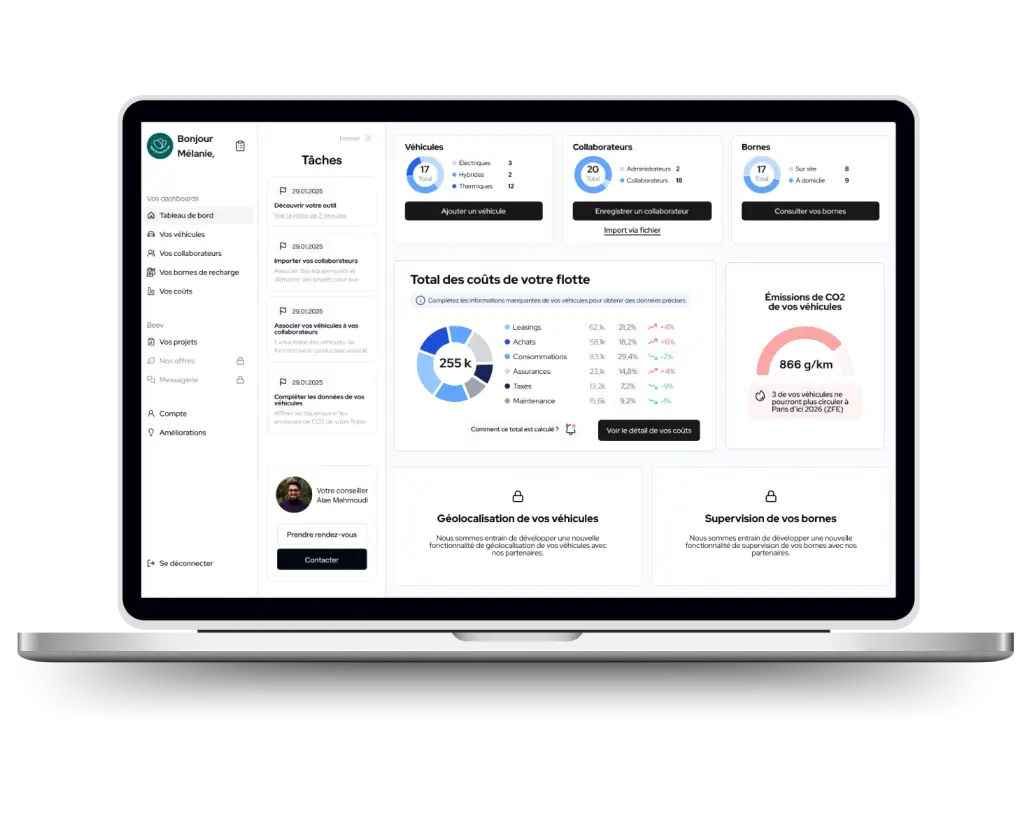
A fleet management tool from A to Z
- Add your fleet and employees in just a few clicks
- Plan your transition to electric vehicles and monitor your CSR objectives in real time
- Centralise your expenses