


























Monday to Friday
9am - 12.30pm - 2pm - 7pm
Why install recharging points on your premises?
Environmental and economic benefits
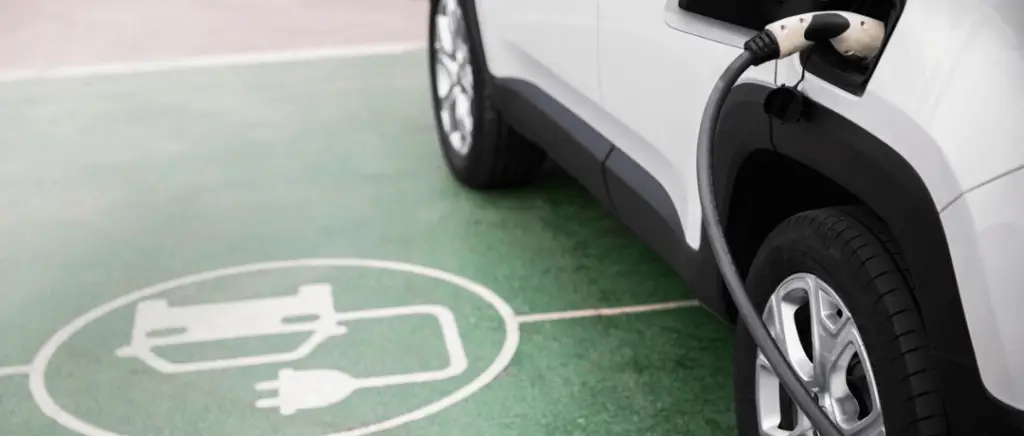
The installation of charging points on company premises offers significant environmental and economic benefits, providing a strategic opportunity for companies committed to the energy transition.
By using electric vehicles, companies are making a direct contribution to reducing greenhouse gas emissions, thereby aligning their activities with the objectives of the the Paris Agreement reduce them 43% by 2030. This not only reduces thecarbon footprint but also to improve air quality.
For the economic benefits of installing charging points on company premises :
- As electric vehicles are less expensive than internal combustion vehicles, the installation of recharging points on company premises means a reduction in transport costs.
- the installation of charging points can pay for itself in just a few years, thanks to the electricity charged back to users.
- companies can benefit from subsidies covering part of the cost of installing charging points.
The installation of charging stations therefore offers businesses an opportunity to support electric mobility while enjoying economic benefits. It's a strategic investment in the environment that aligns with consumer and employee expectations in terms of sustainable development.
Improving brand image
A company's commitment to sustainable development and CSR is now at the heart of strategies to strengthen its brand image. L'installation of recharging stations for electric vehicles is a powerful lever for improving this image with the public, customers and employees.
Read also => Electric cars boost your employer brand
Position yourself as an eco-responsible player
The transition to greener mobility is a growing concern for society. By integrating electric recharging solutions, companies are demonstrating their active participation in this transition. This environmental commitment strengthens their credibility and positions them as forerunners in the fight against climate change. As a result, they attract not only eco-conscious customers, but also talented people who want to be associated with responsible brands.
Promote yourself to your customers and partners
Customers are increasingly looking for brands that are aligned with their values, particularly in terms of sustainability. By making charging stations available, companies can not only enhance the customer experience but also create an important point of competitive differentiation. This demonstrates a willingness to innovate and respond to future needs, qualities that are appreciated and sought after by business partners and investors.
Retaining employees and attracting new talent
Installing charging stations also helps to improve the employer's brand image. By providing infrastructure suitable for electric vehicles, companies demonstrate their commitment to the well-being of their employees and their desire to offer a modern, sustainable working environment. This approach helps retain existing employees and attracts new talent keen to work for a company that shares their environmental values.
Communicating in a greener way
The installation of charging points offers an excellent communication opportunity. Companies can use this commitment as a key element of their green marketing, highlighting their contribution to reducing CO2 emissions and promoting sustainable mobility. This not only strengthens the brand's image with consumers, but also establishes a positive dialogue with local communities and stakeholders in the sector.
What are the benefits for employees?
Installing charging points in businesses offers significant benefits for employees, helping to improve their daily lives and encourage the adoption of electric vehicles. Here are the main benefits:
- Having charging points at work makes life easier for employees, especially those who don't have a home charging solution.
- Companies that offer recharging facilities stand out as employers of choice, promoting the well-being of their employees.
- Financial assistance from ADEMESubsidies for the purchase of electric vehicles, as well as the possibility for employers to reimburse recharging costs, represent significant economic advantages for employers and employees.
Support available for installing recharging points on company premises
The ADVENIR programme
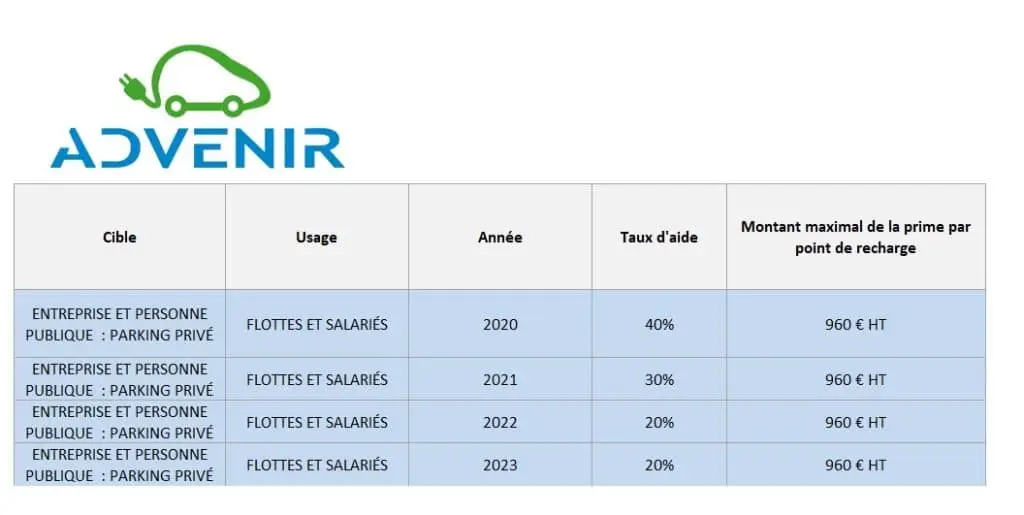
Le Advenir programmelaunched in 2016 and managed by Avere-Franceis designed to support the deployment of charging infrastructure for electric vehicles in France. With a substantial budget and a series of extensions, the programme aims to finance the installation of charging points in a variety of locations, including businesses, condominiums and public spaces.
The programme has been extended several times, with the latest extension running until 2027.
For the 2023-2027 period, a 200 million euros is available to finance more than 72,000 recharging points more.
Advenir has been expanded to include new targets, in particular recharging stations in low-emission zones and recharging points dedicated to two-wheelers, with a focus on compulsory energy management for all installations in order to limit the impact on the electricity network. The amounts of aid have been adjusted, particularly for private car parks for fleets, with a new amount of aid revised downwards and the introduction of a degressive rate of aid year after year.
The programme offers financial support to encourage businesses to install charging points, with the possibility of significant subsidies for charging points open to the public. The Advenir programme therefore plays a crucial role in the transition to more sustainable mobility in France. By facilitating access to charging infrastructure, it encourages the adoption of electric vehicles, helps reduce CO2 emissions, and supports the country's sustainable development objectives.
Also read → The ADVENIR bonus: what will change?
Local aid available
Local support for the installation of charging points for electric vehicles in companies varies from region to region and from local authority to local authority in France. These schemes often complement the Advenir programme and reduce installation costs for businesses:
- tax credit Tax credit: in 2024, private individuals can benefit from a tax credit of 75% of the expenditure incurred for the installation of recharging stations, capped at €300, a scheme that can indirectly benefit employees of companies that install recharging stations on their premises.
- reduced VAT For the installation of charging points, reduced-rate VAT of 5.5% applies, reducing the total cost of installation for businesses and condominiums.
- community support In addition to national schemes, many local authorities offer their own support. This aid can take the form of direct subsidies, additional tax reductions, or technical and financial support.
Companies interested in installing recharging points must also take into account a number of criteria to benefit from this aid:
- installation must be carried out by a IRVE professional,
- The equipment installed must meet certain technical specifications and be eligible under the Advenir programme or local grants,
- The steps to be taken and the documents required vary depending on the type of assistance requested, and may include submitting quotes, carrying out an energy audit, or registering on dedicated platforms.
Also read → Aid for the installation of charging points in 2024
Benefits in kind (BIC) for recharging point installations
Definition and impact on the company and the employee
A benefit in kind is considered to exist when the employer provides an electric charging point for employees' personal vehicles or those supplied by the company. This facility enables employees to recharge their electric vehicles for non-business purposes at no extra cost.
What is the impact on the company?
The preferential social security arrangements applicable to NEAs for electric vehicles and charging points have been extended until 31 December 2024. This means that benefits in kind linked to the provision of electric vehicles and charging points by employers benefit from a partial exemption from social security contributions, subject to certain conditions.
Where the recharging point is installed at the workplace, the benefit in kind resulting from the employee's personal use of it is not taken into account when calculating social security contributions.
What is the impact on the employee?
Employees benefit from partial exemption from taxation on benefits in kind linked to the use of charging points for their electric vehicles, making this benefit more attractive. For electric vehicles made available, an allowance of 50% is applied, up to a maximum of 1,800 euros per year.
If the employer pays for the installation of a terminal at the employee's home, the benefit in kind is assessed differently depending on whether the terminal is returned or kept at the end of the employment contract. The cost of installation and purchase paid by the employer is exempt from social security contributions up to a limit of 50% of expenditure, up to a maximum of €1,000 or €1,500 if the terminal is more than five years old.
NOTES FROM 1ᵉʳ JANUARY 2025, FREE CHARGING OF ELECTRIC VEHICLES AT WORK WILL NO LONGER BE AVAILABLE TO EMPLOYEES.
It should be noted that the employer's contribution towards the costs of using the terminal (servicing, maintenance, additional cost of electricity subscription) is also excluded from the basis for social security contributions, up to a limit of 50% of real expenditure that the employee should have incurred.
Also read → Benefits in kind and electric vehicle
How do you calculate the benefits in kind for a home charging point?
When calculating the benefits in kind for a home charging point, there are two possible scenarios:
- Let's imagine that an employer installs a recharging point at an employee's home for €2,000. If the employee keeps the charging point after the end of their contract within the first five years, the benefit in kind could be calculated on the basis of 50% of the costs, i.e. an exemption limited to €1,000.
- If the terminal is more than five years old and is kept by the employee, and if it costs €2,000 to install it, the exemption could be 75% of the costs, with a ceiling of €1,500.
How to set up a recharging infrastructure in your company?
Choosing your recharging solution
To set up a recharging infrastructure in your company, the choice of recharging solution must be tailored to your needs. This selection depends on a number of criteria:
- charging capacity required,
- number of vehicles to be loaded simultaneously,
- availability of the electricity network on the site.
In addition, there are a number of other factors to consider:
Needs analysisTo do this, you need to determine the number of electric vehicles in your fleet and anticipate their future growth. This will help you choose the right infrastructure.
The type of recharging pointThere are slow, accelerated and fast charging points. Slow charging points are ideal for long-term parking, while fast charging points are ideal for fast charging during working hours.
Turnkey or customised solutionsSome suppliers offer turnkey solutions for businesses, including installation, maintenance and management of the terminals. Others offer the option of fully customising your infrastructure.
Management and accessThe solution chosen must offer easy management of access to the terminals for employees and visitors, with the ability to monitor consumption and optimise use.
Also read → Which charging point should I choose?
Installation and maintenance
When setting up a recharging infrastructure in your company, it's crucial to consider installation and maintenance carefully. This phase involves assessing your specific recharging needs, and choosing equipment that complies with current national and international standards.
| Normes | Portée | Description |
|---|---|---|
|
NF C 15-100
|
France
|
Defines performance requirements
|
|
NF EN 62196-2
|
France
|
Defines safety requirements
|
|
IEC 61851
|
International
|
Defines the technical characteristics
|
Finally, we recommend that you plan your installation so as to minimise disruption to your business. After installation, regular maintenance is essential to ensure the smooth operation and longevity of the equipment. This includes :
- periodic inspections,
- performance testing,
- software updates.
Also read → Compulsory electricity points: electrify your business
In conclusion
Installing a charging infrastructure for electric vehicles is therefore a key step for forward-looking businesses. Not only does it support the energy transition, it will also enhance your brand image. Make sure you choose the right charging solutions, consider professional installation and maintenance, and plan for future growth as your fleet grows.
For more information, we've put together a guide to this topic to explore the different aspects in depth:
If you would like to find out more about the tax credit for in-car charging points 2024For more information, see our article on this subject.
Read our article about :
Contact our experts Beev in recharging stations to help you make the ecological transition for your business.